Pedestrian crossings: Highway Code rules 191 to 199
The short answer
Do not park on a crossing or its zig-zags, or overtake the vehicle nearest the crossing. At a zebra crossing you must give way once someone has stepped on it, and should give way to people waiting. At a pelican crossing, flashing amber means give way to anyone still crossing.
Test yourself · 4
Four questions on crossing rules 191 to 199
-
You have stopped at a zebra crossing for someone waiting on the pavement. They look towards you but stay where they are. How should you respond?
- Wave them across to remove their uncertainty
- Flash your headlights to invite them across
- Give a short horn sound to invite them across
- Wait patiently without beckoning them across Right
The right answer is D: Wait patiently without beckoning them across
WhyAt zebra crossings, wait patiently and avoid inviting people across with gestures, lights or the horn.
Source: The Highway Code, rule 195
-
You want to park on a road that has zig-zag markings before and after a pedestrian crossing. What must you do?
- Park outside the zig-zags where parking is allowed Right
- Stop on the zig-zags for a short time only
- Park on the zig-zags after the crossing
- Stop on the crossing itself briefly
The right answer is A: Park outside the zig-zags where parking is allowed
WhyYou must not park anywhere within the zig-zag markings at a crossing.
Source: Know Your Traffic Signs: Pedestrian, cycle and equestrian crossings
-
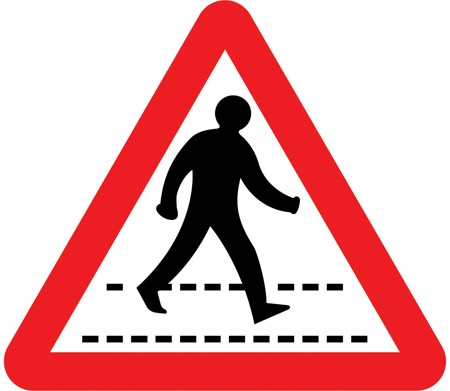
What does this sign mean?
- Traffic lights are ahead
- A zebra or parallel crossing is ahead Right
- No parking, waiting or overtaking near a crossing
- Watch for children near a school
The right answer is B: A zebra or parallel crossing is ahead
WhyPedestrian crossing sign. This warning sign means there is a zebra or parallel crossing ahead. Be ready to stop: you must give way to anyone who has stepped onto the crossing.
Source: The Highway Code, rule 195, GOV.UK, The Highway Code, rule H2, GOV.UK, Know your traffic signs: warning signs, GOV.UK, Know your traffic signs: pedestrian, cycle and equestrian crossings, GOV.UK, The Highway Code: traffic signs, GOV.UK, Traffic sign images, Department for Transport, GOV.UK
-
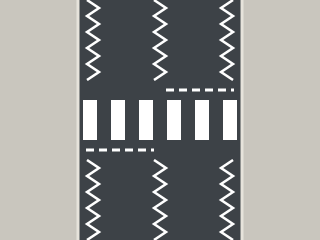
What do these markings mean?
- Watch for children near a school
- No parking, waiting or overtaking near a crossing Right
- A zebra or parallel crossing is ahead
- Single and double yellow waiting restrictions
The right answer is B: No parking, waiting or overtaking near a crossing
WhyZigzag lines. White zigzag lines at a crossing mean you must not park there and must not overtake the vehicle nearest the crossing. Yellow zigzags outside schools show where you should not stop.
Source: The Highway Code, rule 191, GOV.UK, The Highway Code, rule 240, GOV.UK, Know your traffic signs: pedestrian, cycle and equestrian crossings, GOV.UK, Know your traffic signs: on-street parking control signs and road markings, GOV.UK, The Highway Code: road markings, GOV.UK
Your first full mock test in the app is free.
Your topics
- Road and traffic signsKnow it
- Motorway rulesOn the way
- Vulnerable road usersStamped
In the app, questions you miss come back until you get them right. 5 questions a day are free.
62 free questions on this website and 372 in the app, checked against The Highway Code, with the reason for every answer. About the app
Out now on iPhone and Android.


32 more questions in the app
Practise free nowThe rule in plain words
The zig-zag lines on both sides of a crossing are a no-go zone for parking, and you must not overtake the moving vehicle nearest the crossing, or the one that has stopped there to let people cross (rule 191). In slow traffic, keep the crossing clear: only drive onto it if you can get all the way across (rule 192).
At a zebra crossing look out for people waiting and be ready to stop. You should give way to them, and you must give way once someone has stepped onto the crossing. A parallel crossing works the same way, with a cycle path next to the stripes, so cyclists get the same priority (rule 195).
At a pelican crossing the red light is followed by flashing amber. On flashing amber you must give way to anyone still on the crossing, and may go on with care if it is empty (rule 196). Puffin, toucan and equestrian crossings have no flashing amber: their lights work like ordinary traffic lights (rule 199). In the Highway Code’s words: “Allow pedestrians plenty of time to cross”.
What rules 191 to 199 say
| Rule | What it means for you |
|---|---|
| 191 | Do not park on the crossing or the zig-zags. Do not overtake the moving vehicle nearest the crossing, or one stopped there to let people cross. |
| 192 | Keep crossings clear in queues. Do not block advanced stop lines for cycles. |
| 193 | Take extra care when queuing or parked vehicles hide the crossing. People may step out between them. |
| 194 | Give people plenty of time. Do not rev your engine or edge forward. |
| 195 | Zebra and parallel crossings: give way to people waiting; you must give way once they are on it. Do not wave them across. |
| 196 to 197 | Pelican crossings: stop on red; on flashing amber give way to anyone crossing. A straight pelican crossing with an island is one crossing. |
| 198 | At any crossing, give way to someone still crossing after your light turns green. |
| 199 | Puffin, toucan and equestrian crossings: no flashing amber. If the lights are not working, go with great care. |
Take the free practice quiz
Practise free nowWhat it means in practice
Someone is waiting at a zebra crossing but does not step out
Stop and wait patiently. Do not wave, flash your lights or sound your horn to invite them across. A car coming the other way may not have stopped (rule 195).
A zebra crossing with an island in the middle
It counts as two separate crossings. A pelican crossing that goes straight across counts as one, even with an island, so you must wait for people coming from the far side too (rule 197).
Your light turns green while someone is still crossing
Wait. Rule 198 says give way to anyone still crossing after the signal for vehicles has changed to green, at every kind of crossing.
Common mistakes
- Stopping on the zig-zags to drop someone off. Rule 240 says you must not stop or park on a crossing or its zig-zags, and rule 191 adds no overtaking there.
- Beckoning people across. It can lead them into the path of another car.
- Edging forward or revving. It hurries people. Older pedestrians and people with walking difficulties may need more time (rule 207).
- Treating flashing amber as go. It means give way to anyone still on the crossing.
- Stopping on the crossing in a queue. Only drive onto it if you can clear it completely.
Questions about pedestrian crossings
Do you have to stop at a zebra crossing if someone is waiting?
You should give way to people waiting to cross, and you must give way once someone has moved onto the crossing. Source: rule 195.
What does flashing amber mean at a pelican crossing?
You must give way to anyone on the crossing. If it is empty, you may go on with care. Source: rule 196.
Can you park on zig-zag lines?
No. You must not park on a crossing or in the area covered by the zig-zag lines. Source: rule 191.
What is a parallel crossing?
A zebra crossing with a cycle route next to the black and white stripes. You must give way to people walking and cycling once they are on it. Source: rule 195.
Read next
- Rules of the road theory test questions
- Zig-zag lines: what they mean
- Pedestrian crossing sign
- The hierarchy of road users: rules H1 to H3
- Pedestrians and children: rules 204 to 210
Sources
(3)
- The Highway Code: pedestrian crossings (rules 191 to 199), GOV.UK. Checked 4 November 2026.
- The Highway Code, rule 195 (zebra and parallel crossings), GOV.UK. Checked 4 November 2026.
- The Highway Code, rule 196 (pelican crossings), GOV.UK. Checked 4 November 2026.
Contains public sector information licensed under the Open Government Licence v3.0. Quotes from The Highway Code and the sign image are Crown copyright. Sources and image credits.
Get the app free
Play with friends and family, and keep practising with every answer explained.