Theory test questions by topic
55 sample questions from our 372 checked questions across the 14 theory test topics, with reasons and sources for every answer. Hazard perception is not covered.
Checked against GOV.UK · Report a mistake
Sample questions from all 14 topics
One question from each topic of the car theory test, with the answer, the reason and the rule or guidance behind it.
One question from each topic
Settings 14 questions · see the answer after each question
How many questions?
Changing a setting starts the round again.
-
Which of these does the Highway Code list as a distraction to avoid while driving?
- Listening for emergency sirens
- Glancing at your speedometer
- Eating or drinking Right
- Checking your mirrors
The right answer is C: Eating or drinking
WhyEating and drinking are distractions; keep your full attention on the road.
Source: The Highway Code, rule 148
-
You have stopped at a zebra crossing for someone waiting on the pavement. They look towards you but stay where they are. How should you respond?
- Wave them across to remove their uncertainty
- Flash your headlights to invite them across
- Give a short horn sound to invite them across
- Wait patiently without beckoning them across Right
The right answer is D: Wait patiently without beckoning them across
WhyAt zebra crossings, wait patiently and avoid inviting people across with gestures, lights or the horn.
Source: The Highway Code, rule 195
-
You are arranging unpaid practice in a manual car. Each person below is over 25 and has held their stated full UK licence for four years. Who meets the licence requirement to supervise you?
- Someone with a full manual car licence Right
- Someone with an automatic-only car licence
- Someone with a motorcycle licence but no car licence
- Someone with an automatic car licence and manual lessons
The right answer is A: Someone with a full manual car licence
WhyA supervisor must be qualified for the type of car you drive, including a manual licence for a manual car.
Source: GOV.UK: Driving lessons and learning to drive — Practising with family or friends
-
You are following a slow-moving car through a residential stretch with traffic-calming chicanes. The road briefly widens between two chicanes. What should you do about overtaking?
- Overtake in the wider section before the next chicane
- Stay behind while within the traffic-calming stretch Right
- Overtake if the car ahead is below the speed limit
- Overtake after signalling to warn the driver ahead
The right answer is B: Stay behind while within the traffic-calming stretch
WhyDo not overtake moving road users within a stretch of traffic-calming measures.
Source: The Highway Code, rule 153
-
An adult casualty is unresponsive and not breathing normally after a collision. When you start CPR, how should you give chest compressions?
- Gently press the upper chest once a second
- Press firmly once every five seconds
- Press hard and fast in the centre, about 5 to 6 cm deep Right
- Press the chest only if you are trained
The right answer is C: Press hard and fast in the centre, about 5 to 6 cm deep
WhyFor an adult, press the centre of the chest hard and fast, about 5 to 6 cm deep and twice a second.
Source: The Highway Code, Annex 7, Emergency care (Breathing)
-
A passenger asks you to let them out on a motorway verge near a path. There is no emergency. How should you respond?
- Stop on the verge if the passenger can leave quickly
- Stop on the hard shoulder with your hazard lights on
- Continue without setting the passenger down Right
- Use an emergency area to let the passenger out
The right answer is C: Continue without setting the passenger down
WhyYou must not pick up or set down anyone on a motorway except in an emergency.
Source: The Highway Code, rule 272
-
Your lane is queuing beside an empty bus lane. Its operating period is in force, and the signs give your car no permission to use it. You want to continue along the road. What should you do?
- Stay out of the bus lane Right
- Use the bus lane until a bus appears
- Use the bus lane while traffic is queuing
- Enter the bus lane if you keep moving
The right answer is A: Stay out of the bus lane
WhyUnless indicated otherwise, you should stay out of a bus lane during its operating period.
Source: The Highway Code, rule 141
-
You are waiting to turn left. The signals controlling your lane show a red light and an illuminated green left arrow. The route to your left is clear. What may you do?
- Turn left Right
- Proceed straight ahead instead
- Turn right if that route is clear
- Move only when the full green appears
The right answer is A: Turn left
WhyA green arrow permits travel in its direction when clear, even while other lights show red.
-
You want to cross a dual carriageway. Its central reservation is too shallow to shelter the full length of your car. Traffic on the nearer carriageway clears, but traffic continues on the farther one. What should you do?
- Wait for a safe gap across both carriageways Right
- Cross halfway and wait with the rear of your car protruding
- Enter the reservation and ask farther traffic to let you out
- Cross the nearer carriageway and edge into the farther one
The right answer is A: Wait for a safe gap across both carriageways
WhyIf the central reservation cannot shelter your full vehicle, wait until you can cross both carriageways in one go.
Source: The Highway Code, rule 173
-
In icy or snowy weather, stopping distances can reach how many times the dry distance?
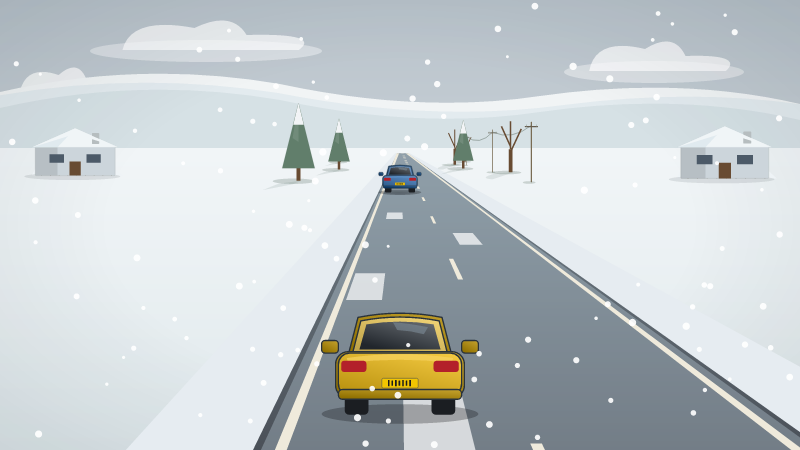
- Ten times Right
- Two times
- Three times
- Five times
The right answer is A: Ten times
WhyIn icy or snowy weather, stopping distances can be ten times greater than on dry roads.
Source: The Highway Code, rule 230
-
You are driving in fog and a vehicle is following too closely behind you. Which of these should you **not** do?
- Check your mirrors before you slow down
- Use your brake lights to warn when slowing down
- Keep a safe distance from the vehicle in front
- Accelerate to get away from it Right
The right answer is D: Accelerate to get away from it
WhyIn fog, do not accelerate to get away from a vehicle that is too close behind (rule 235).
Source: The Highway Code, rule 235
-
You join a motorway while towing a caravan with your car. No lower speed limit is displayed. What is the maximum speed allowed for your combination?
- 50 mph
- 60 mph Right
- 70 mph
- 30 mph
The right answer is B: 60 mph
WhyA car towing a caravan has a motorway speed limit of 60 mph.
-
Fog has cleared and you can see clearly. What should you do with your fog lights?
- Leave them on to be seen
- Keep them on until you park
- Keep only the rear fog light on
- Switch them off Right
The right answer is D: Switch them off
WhyRule 236 says you must switch fog lights off when visibility improves.
Source: The Highway Code, rule 236
-
You are overtaking a cyclist at 40 mph. What clearance should you leave?
- More than 1.5 metres Right
- 1.5 metres is always enough
- At least half a metre
- One metre
The right answer is A: More than 1.5 metres
WhyLeave more than 1.5 metres when overtaking cyclists at speeds above 30 mph.
Source: The Highway Code, rule 163
Your first full mock test in the app is free.
Your topics
- Road and traffic signsKnow it
- Motorway rulesOn the way
- Vulnerable road usersStamped
In the app, questions you miss come back until you get them right. 5 questions a day are free.
14 questions in this test · 62 free questions on this website and 372 in the app, checked against The Highway Code, with the reason for every answer. About the app
Out now on iPhone and Android.


Choose a topic to practise
Working on one area at a time can help you decide what to read again. Each topic page holds the public sample from that part of our checked bank, in a free browser quiz with answers and explanations.
- Alertness5 free questions here · 20 in the appStart ›
- Attitude3 free questions here · 20 in the appStart ›
- Safety and your vehicle4 free questions here · 22 in the appStart ›
- Safety margins5 free questions here · 21 in the appStart ›
- Hazard awareness4 free questions here · 21 in the appStart ›
- Vulnerable road users4 free questions here · 26 in the appStart ›
- Other types of vehicle3 free questions here · 20 in the appStart ›
- Vehicle handling3 free questions here · 23 in the appStart ›
- Motorway rules4 free questions here · 25 in the appStart ›
- Rules of the road5 free questions here · 28 in the appStart ›
- Road and traffic signs5 free questions here · 31 in the appStart ›
- Essential documents3 free questions here · 23 in the appStart ›
- Incidents, accidents and emergencies4 free questions here · 25 in the appStart ›
- Vehicle loading3 free questions here · 20 in the appStart ›
How to use these questions
Choose a topic you want to revisit and take your time with the answers. Open the source linked in an explanation to read the guidance behind it. You can return to any question and compare the choices without a time limit.
These are our own questions, drafted with AI help and checked against The Highway Code and GOV.UK guidance. They are not the real test questions and no driving instructor has reviewed them. Read how we write and check our questions.
Practise with mixed questions
The free timed practice quiz uses 50 of these 55 public questions. Questions on the topic pages also appear in the practice quiz, so a familiar question may come up again. The practice quiz covers all 14 topics and is scored against 43 out of 50.
This is multiple-choice practice. Hazard perception is not covered; read our hazard perception guide to learn about that separate part. The theory test guide explains the test, while our Highway Code quizzes offer short sessions on selected rules.
Sources
(7)
- Driving lessons and learning to drive, GOV.UK
- The Highway Code: Annex 7. First aid on the road, GOV.UK
- The Highway Code: Driving in adverse weather conditions (226 to 237), GOV.UK
- The Highway Code: General rules, techniques and advice for all drivers and riders (103 to 158), GOV.UK
- The Highway Code: Light signals controlling traffic, GOV.UK
- The Highway Code: Motorways (253 to 274), GOV.UK
- The Highway Code: Using the road (159 to 203), GOV.UK
Contains public sector information licensed under the Open Government Licence v3.0.
Common questions about these questions
How many questions are in the car theory test?
The multiple-choice part has 50 questions and lasts 57 minutes, and you need 43 right to pass. Source: GOV.UK, multiple-choice questions; pass mark and result.
Are these the real DVSA theory test questions?
No. The DVSA does not publish the real test questions. These are our own practice questions, written from the Highway Code and other official guidance, and each one links to its source.
How many topics do the questions cover?
The 14 topics listed above. Each topic page has free sample questions with answers and the rule behind each one.
Is it free, and do I need to sign up?
Yes, it is free in your browser and needs no sign-up. The web shows a sample of our checked questions and one 50-question timed practice quiz; the rest are kept for the app.