Pedestrians and children: Highway Code rules 204 to 210
The short answer
Expect people, especially children, to step into the road without warning, and drive slowly where they are likely to be. Be patient with older and disabled people who need more time to cross. You must stop when a school crossing patrol shows its Stop for children sign.
Test yourself · 4
Four questions on pedestrians and children
-
According to the Highway Code, what is the chance that a pedestrian hit by a vehicle at 20 mph is killed?
- 1 in 2
- 1 in 5
- 1 in 20 Right
- 1 in 100
The right answer is C: 1 in 20
WhyAt 20 mph there is only a 1 in 20 chance of the pedestrian being killed. At 40 mph your vehicle will probably kill any pedestrian it hits.
Source: The Highway Code, rule 207
-
A pedestrian stands at the kerb ahead, looking away from your approaching car. What should you anticipate?
- They will always turn towards you before stepping out
- They will stay on the pavement until traffic stops
- They have noticed you even though they are looking away
- They may step into the road without seeing you Right
The right answer is D: They may step into the road without seeing you
WhyPedestrians looking the other way may step into the road without seeing you.
Source: The Highway Code, rule 146
-
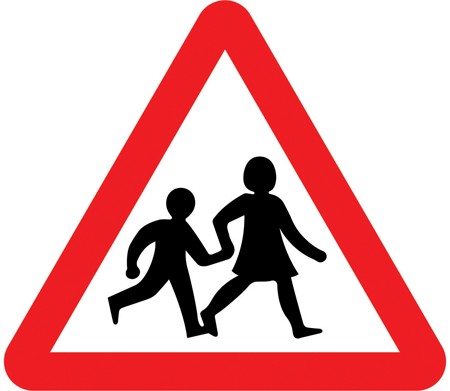
What does this sign mean?
- Watch for children near a school Right
- No parking, waiting or overtaking near a crossing
- Maximum speed 30 mph
- A zebra or parallel crossing is ahead
The right answer is A: Watch for children near a school
WhyChildren going to or from school sign. This sign warns that children may be crossing or walking near the road on their way to or from school. Slow down and be ready to stop.
Source: The Highway Code, rule 208, GOV.UK, The Highway Code, rule 210, GOV.UK, Know your traffic signs: warning signs, GOV.UK, The Highway Code: traffic signs, GOV.UK, Traffic sign images, Department for Transport, GOV.UK
-
You are turning into a side road and someone is waiting to cross it. What should you do?
- Give way to them Right
- Turn before they step out
- Sound your horn
- Expect them to wait
The right answer is A: Give way to them
WhyAt a junction you should give way to pedestrians crossing or waiting to cross a road into which or from which you are turning.
Source: The Highway Code, rule H2
Your first full mock test in the app is free.
Your topics
- Road and traffic signsKnow it
- Motorway rulesOn the way
- Vulnerable road usersStamped
In the app, questions you miss come back until you get them right. 5 questions a day are free.
62 free questions on this website and 372 in the app, checked against The Highway Code, with the reason for every answer. About the app
Out now on iPhone and Android.


48 more questions in the app
Practise free nowThe rule in plain words
People walking, and children above all, are the road users most at risk. Rule 204 says those who can do the most harm carry the most responsibility to reduce the danger.
Children (rules 205, 206 and 208 to 210). Children may step out without warning, so drive at a speed that keeps them safe. Slow right down in busy shopping streets, home zones and residential areas, past bus and tram stops, past parked cars and ice cream vans, and near schools. Pass a stopped school bus slowly. You must stop when a school crossing patrol shows a Stop for children sign.
Speed (rule 207). The Highway Code puts numbers on it: at 40 mph a car will probably kill any pedestrian it hits, but at 20 mph there is only a 1 in 20 chance of the pedestrian being killed. In its words: “So kill your speed”.
Older and disabled people (rule 207). Older people may need more time to cross: be patient and do not hurry them by revving or edging forward. Deaf people may not hear you coming. Blind or partially sighted people may carry a white cane or use a guide dog. A white cane with a red band, or a dog with a red and white harness, means the person is deafblind.
What rules 204 to 210 say
| Rule | What it means for you |
|---|---|
| 204 | Pedestrians, cyclists, horse riders and motorcyclists are most at risk. Those who can cause the most harm carry the most responsibility. |
| 205 | Children may step out unexpectedly. Drive with their safety in mind. |
| 206 | Drive slowly in busy streets, past bus stops and parked cars, at road works, when turning at junctions and on country roads with no pavement. |
| 207 | At 20 mph a pedestrian has a 1 in 20 chance of being killed; at 40 mph they will probably be killed. Give older and disabled people time. |
| 208 | Near schools, drive slowly. A flashing amber light under a School sign means children may be crossing. |
| 209 | Pass a stopped bus showing a School Bus sign carefully and slowly. |
| 210 | You must stop for a school crossing patrol showing a Stop for children sign. |
Try the free vulnerable road users quiz
Practise free nowWhat it means in practice
An ice cream van parked in a residential street
Slow right down and be ready to stop. Rule 206 warns that children are more interested in ice cream than traffic and may run out.
A pedestrian at the kerb looking the other way
They may step out without seeing you. Rule 146 says to try to anticipate what pedestrians might do, especially children who are looking the other way.
Reversing into a side road
Look all around the car and give way to anyone crossing behind you (rule 206).
Common mistakes
- Driving at the limit past a school at home time. The limit is a maximum. Near schools, drive slowly.
- Hurrying an older person across. Do not rev or edge forward. Let them cross in their own time.
- Ignoring a flashing amber light under a School sign. It means children may be crossing ahead: drive very slowly.
- Passing a school bus at normal speed. Children may be getting on or off.
Questions about pedestrians and children
What does rule 207 say about speed?
At 40 mph your vehicle will probably kill any pedestrian it hits. At 20 mph there is only a 1 in 20 chance of the pedestrian being killed. Source: rule 207.
Do you have to stop for a lollipop person?
Yes. You must stop when a school crossing patrol shows a Stop for children sign. Source: rule 210.
What does a white cane with a red band mean?
The person is deafblind. They may not see or hear instructions or signals. Source: rule 207.
Do pedestrians have priority at a junction?
If they are crossing or waiting to cross the road you are turning into or out of, you should give way to them. Source: rule H2.
Read next
- Vulnerable road users theory test questions
- Pedestrian crossings: rules 191 to 199
- The hierarchy of road users: rules H1 to H3
- Children going to school sign and frail pedestrians sign
Sources
(2)
- The Highway Code: road users requiring extra care, pedestrians (rules 204 to 210), GOV.UK. Checked 4 November 2026.
- The Highway Code, rule 146, GOV.UK. Checked 4 November 2026.
Contains public sector information licensed under the Open Government Licence v3.0. Quotes from The Highway Code and the sign image are Crown copyright. Sources and image credits.
Get the app free
Play with friends and family, and keep practising with every answer explained.