Overtaking: Highway Code rules 162 to 169
The short answer
Overtake only when it is safe and legal: the road ahead is clear, nobody is overtaking you and there is a gap to move back into. Do not overtake near junctions, bends, crossings or a No Overtaking sign, and do not cross a solid white line on your side, except in the few cases rule 129 allows.
Test yourself · 5
Five questions on overtaking rules 162 to 169
-
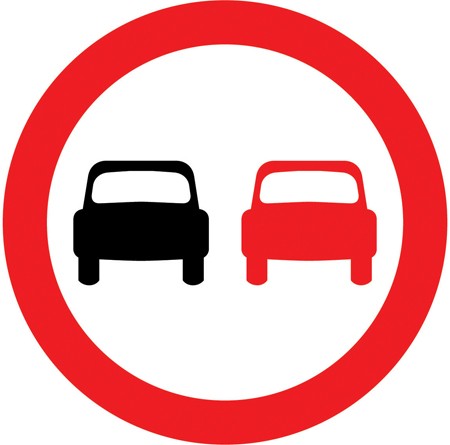
What does this sign mean?
- Do not overtake until the restriction ends Right
- Diagonal stripes that separate traffic
- The road bends ahead, here to the right
- The line nearer to you decides if you may cross
The right answer is A: Do not overtake until the restriction ends
WhyNo overtaking sign. The no overtaking sign means you must not overtake until you pass a sign that cancels the restriction (Highway Code rule 165).
Source: The Highway Code, rule 165, GOV.UK, The Highway Code, rule 166, GOV.UK, Know your traffic signs: regulatory signs, GOV.UK, The Highway Code: traffic signs, GOV.UK, Traffic sign images, Department for Transport, GOV.UK
-
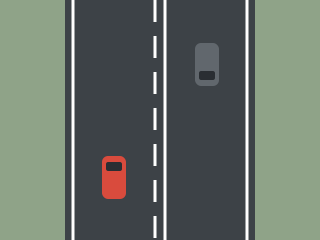
What do these markings mean?
- Do not overtake until the restriction ends
- The road bends ahead, here to the right
- Diagonal stripes that separate traffic
- The line nearer to you decides if you may cross Right
The right answer is D: The line nearer to you decides if you may cross
WhyDouble white lines. With double white lines, the line nearer to you decides. If it is solid, you must not cross or straddle it except in a few cases. If it is broken, you may cross to overtake when it is safe.
Source: The Highway Code, rule 128, GOV.UK, The Highway Code, rule 129, GOV.UK, The Highway Code, rule 240, GOV.UK, The Highway Code: road markings, GOV.UK, Know your traffic signs: road markings, GOV.UK
-
You are following a slow-moving car through a residential stretch with traffic-calming chicanes. The road briefly widens between two chicanes. What should you do about overtaking?
- Overtake in the wider section before the next chicane
- Stay behind while within the traffic-calming stretch Right
- Overtake if the car ahead is below the speed limit
- Overtake after signalling to warn the driver ahead
The right answer is B: Stay behind while within the traffic-calming stretch
WhyDo not overtake moving road users within a stretch of traffic-calming measures.
Source: The Highway Code, rule 153
-
On a dry high-speed road, a car overtakes you and moves into the space ahead. Your following gap is now less than two seconds. What should you do?
- Drop back to restore at least a two-second gap Right
- Keep the smaller gap because the other driver created it
- Accelerate towards the car to discourage another overtake
- Keep the smaller gap until the car leaves your lane
The right answer is A: Drop back to restore at least a two-second gap
WhyIf an overtaking vehicle pulls into your gap, drop back to maintain a two-second gap.
Source: The Highway Code, rule 168, The Highway Code, rule 126
-
You are on a three-lane dual carriageway and have just overtaken using the right-hand lane. The road ahead is clear. What should you do next?
- Stay in the right-hand lane until your exit
- Return to the middle lane, then the left-hand lane Right
- Stay in the middle lane for the rest of the journey
- Return to the left-hand lane only if it gets busy
The right answer is B: Return to the middle lane, then the left-hand lane
WhyAfter overtaking, return through the middle lane to the left-hand lane when it is safe to do so.
Source: The Highway Code, rule 138
Your first full mock test in the app is free.
Your topics
- Road and traffic signsKnow it
- Motorway rulesOn the way
- Vulnerable road usersStamped
In the app, questions you miss come back until you get them right. 5 questions a day are free.
62 free questions on this website and 372 in the app, checked against The Highway Code, with the reason for every answer. About the app
Out now on iPhone and Android.


31 more questions in the app
Practise free nowThe rule in plain words
Before you overtake, check three things (rule 162): the road ahead is clear enough, nobody behind is starting to overtake you, and there is a gap in front of the vehicle you want to pass. Then use mirrors, signal and move out. Get past quickly, give plenty of room and move back to the left as soon as you can, without cutting in (rule 163).
Some places are off limits by law (rule 165). Others are simply too risky (rules 166 and 167): bends, hump bridges, the brow of a hill, junctions, crossings, school crossing patrols, level crossings and queues. In the Highway Code’s words: “DO NOT overtake if there is any doubt”.
What rules 162 to 169 say
| Rule | What it means for you |
|---|---|
| 162 | Check the road ahead is clear, nobody is overtaking you, and there is a gap to return to. |
| 163 | Mirrors, signal, manoeuvre. Pass quickly, do not cut in. Overtake on the left only if the vehicle ahead is signalling to turn right and there is room. Give cyclists, riders and walkers at least as much room as a car. |
| 164 | Large vehicles: drop back to see past, and only go if you have room to finish. |
| 165 | You must not overtake where you would cross a solid white line on your side (with the exceptions in rule 129), into an area with a solid border, past the vehicle nearest a pedestrian crossing, into a bus, tram or cycle lane in its hours, or after a No Overtaking sign. |
| 166 | Do not overtake if you cannot see far enough ahead: bends, hump bridges, the brow of a hill. |
| 167 | Do not overtake where you could clash with others: junctions, narrowings, crossings, queues, level crossings, a vehicle signalling right. |
| 168 | Being overtaken: keep a steady course and speed, never speed up, and drop back to a two-second gap if someone pulls in ahead. |
| 169 | Do not hold up a long queue. If needed, pull in where it is safe and let traffic pass. |
Take the free practice quiz
Practise free nowWhat it means in practice
Double white lines
If the line nearer to you is broken, you may cross to overtake when it is safe, as long as you can be back before a solid line on your side (rule 128). If the line nearer to you is solid, you must not cross it, except in a few cases such as passing a stopped vehicle, or a cyclist, horse or road maintenance vehicle doing 10 mph or less (rule 129).
Someone overtakes you and pulls in close
Ease off and drop back until you have at least a two-second gap again. Rule 168 says never speed up or drive unpredictably while someone is overtaking you.
A slow car through a traffic-calmed street
The road widens for a moment between two chicanes. Stay behind: rule 153 says you should not overtake moving road users in traffic-calming areas.
Common mistakes
- Following another car out to overtake. There may only be room for one vehicle (rule 163).
- Passing on the left because the lane is clear. Only overtake on the left if the vehicle in front is signalling to turn right and there is room. In slow queues you may pass on the left if the queue on your right is moving more slowly.
- Overtaking the car that stopped at a crossing. It may have stopped for someone you cannot see. You must not overtake it.
- Cutting in after passing a lorry. Rule 164: make sure you have room to finish before you commit.
- Speeding up when being overtaken. It is dangerous. Hold a steady speed or slow down.
Questions about overtaking rules
When must you not overtake?
Rule 165 lists the legal bans: across a solid white line on your side (rule 129 gives a few exceptions), into an area with a solid white border, the vehicle nearest a pedestrian crossing, into a bus, tram or cycle lane during its hours, and after a No Overtaking sign. Source: rule 165.
Can you overtake on the left in the UK?
Only if the vehicle in front is signalling to turn right and there is room, or in slow queues when you stay in your lane and the queue on your right is moving more slowly than yours. In one-way streets traffic may pass on both sides. Source: rule 163.
What should you do when someone overtakes you?
Keep a steady course and speed, slow down if needed to let them pass, and drop back to a two-second gap if they pull in ahead of you. Source: rule 168.
Can you cross a solid white line to overtake a cyclist?
Yes, if the road is clear and the cyclist is going at 10 mph or less. The same goes for a horse or a road maintenance vehicle. Source: rule 129.
Read next
- Rule 163: how much space to give cyclists, horses and walkers
- Rules of the road theory test questions
- No overtaking sign and double white lines
- Lanes, bus lanes and cycle lanes: rules 133 to 143
Sources
(3)
- The Highway Code: overtaking (rules 162 to 169), GOV.UK. Checked 4 November 2026.
- The Highway Code, rules 128 and 129 (double white lines), GOV.UK. Checked 4 November 2026.
- The Highway Code, rule 153 (traffic-calming measures), GOV.UK. Checked 4 November 2026.
Contains public sector information licensed under the Open Government Licence v3.0. Quotes from The Highway Code and the sign image are Crown copyright. Sources and image credits.
Get the app free
Play with friends and family, and keep practising with every answer explained.