Lanes, bus lanes and cycle lanes: rules 133 to 143
The short answer
Check your mirrors before you change lane and do not force anyone to brake or swerve. On a dual carriageway keep left and use the right lane to overtake or turn right. Stay out of bus lanes during their hours unless the signs say your vehicle may use them.
Test yourself · 4
Four questions on lanes and bus lanes
-
You are on a three-lane dual carriageway and have just overtaken using the right-hand lane. The road ahead is clear. What should you do next?
- Stay in the right-hand lane until your exit
- Return to the middle lane, then the left-hand lane Right
- Stay in the middle lane for the rest of the journey
- Return to the left-hand lane only if it gets busy
The right answer is B: Return to the middle lane, then the left-hand lane
WhyAfter overtaking, return through the middle lane to the left-hand lane when it is safe to do so.
Source: The Highway Code, rule 138
-
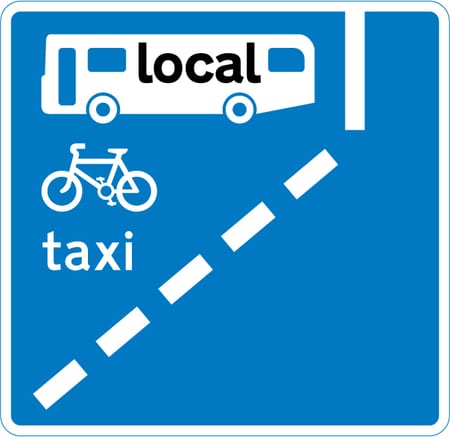
Your lane is queuing beside an empty bus lane. Its operating period is in force, and the signs give your car no permission to use it. You want to continue along the road. What should you do?
- Stay out of the bus lane Right
- Use the bus lane until a bus appears
- Use the bus lane while traffic is queuing
- Enter the bus lane if you keep moving
The right answer is A: Stay out of the bus lane
WhyUnless indicated otherwise, you should stay out of a bus lane during its operating period.
Source: The Highway Code, rule 141
-
What does this sign mean?
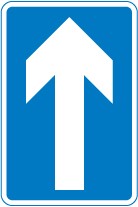
- All traffic goes in the direction of the arrow Right
- Pass on the left of the island or bollard
- Traffic ahead goes in both directions
- No vehicles may go in from this side
The right answer is A: All traffic goes in the direction of the arrow
WhyOne-way traffic sign. The one-way traffic sign, a white arrow on a blue rectangle, means traffic on that road may only travel in the direction of the arrow.
Source: The Highway Code, rule 143, GOV.UK, Know your traffic signs: regulatory signs, GOV.UK, The Highway Code: traffic signs, GOV.UK, Traffic sign images, Department for Transport, GOV.UK
-
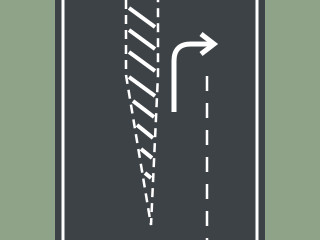
What do these markings mean?
- The line nearer to you decides if you may cross
- Diagonal stripes that separate traffic Right
- Double broken white lines across a junction
- Bars that count down to a motorway exit
The right answer is B: Diagonal stripes that separate traffic
WhyHatched markings. Hatched markings separate traffic lanes or protect traffic turning right. With a broken border, enter only if necessary and safe; with chevrons (V-shaped stripes) and a solid border, only in an emergency.
Source: The Highway Code, rule 130, GOV.UK, The Highway Code: road markings, GOV.UK, Know your traffic signs: road markings, GOV.UK
Your first full mock test in the app is free.
Your topics
- Road and traffic signsKnow it
- Motorway rulesOn the way
- Vulnerable road usersStamped
In the app, questions you miss come back until you get them right. 5 questions a day are free.
62 free questions on this website and 372 in the app, checked against The Highway Code, with the reason for every answer. About the app
Out now on iPhone and Android.


31 more questions in the app
Practise free nowThe rule in plain words
Changing lanes (rules 133 and 134). Mirrors first, and a quick look over your shoulder if needed, so you do not force anyone to change speed or direction. Signal, then move over when it is clear. Follow the lane signs and markings, and in a queue do not keep changing lanes. Merging in turn is recommended when traffic is moving very slowly, for example at road works, but not at high speed.
Three-lane roads and dual carriageways (rules 135 to 138). On a single carriageway with three lanes and no markings giving priority, the middle lane is only for overtaking or turning right, and the oncoming traffic has as much right to it as you. Do not use the right-hand lane. On a two-lane dual carriageway stay in the left lane and move back after overtaking. With three or more lanes, return to the middle lane and then the left lane when it is safe.
Bus, cycle and other lanes (rules 140 to 142). Unless the signs show otherwise, do not drive in a bus lane during its hours. You may go into one to stop, load or unload where that is not banned. You must not drive or park in a cycle lane with a solid white line during its hours. In the Highway Code’s words: “Bear in mind that cyclists are not obliged to use cycle lanes or cycle tracks.”
One-way streets (rule 143). You must follow the direction the signs show. Choose your lane early: left for left, right for right, and the most suitable one for straight on. Traffic may pass you on both sides.
What rules 133 to 143 say
| Rule | What it means for you |
|---|---|
| 133 to 134 | Mirrors, a quick look if needed, signal, then change lane. Do not change lanes for no reason in queues. Merge in turn only at very low speed. |
| 135 | Three-lane single carriageway where no signs or markings give priority: the middle lane is only for overtaking or turning right. Do not use the right-hand lane. |
| 137 to 138 | Dual carriageway: keep left, overtake on the right, then move back to the middle and left lanes. |
| 139 | Climbing or crawler lane: use it if you are slow or if others want to overtake. |
| 140 | Cycle lanes: you must not drive or park in one with a solid line during its hours. Give way to cyclists in the lane when you turn. |
| 141 | Bus lanes: stay out during their hours unless signs allow your vehicle. You may enter to stop, load or unload where that is allowed. |
| 142 | High-occupancy and other special lanes: use them only if the signs say your vehicle may. |
| 143 | One-way streets: follow the signs, get in lane early, and expect traffic on both sides. |
Try the free road markings and box junctions quiz
Practise free nowWhat it means in practice
Your lane is queuing beside an empty bus lane
Check the sign. If the bus lane is in its hours and your car is not shown on the sign, stay in your lane. An empty bus lane is not an invitation.
Road works ahead and your lane is closing
When traffic is moving very slowly, merge in turn with the cars in the next lane, if it is safe. At high speed, merging in turn is not recommended (rule 134).
White diagonal stripes in the middle of the road
They separate traffic or protect drivers turning right. If the area has a broken white border, stay out unless you need to go in and can see it is safe. If it is marked with chevrons and has a solid white border, you must not go in except in an emergency (rule 130).
Common mistakes
- Changing lanes without a mirror check. Someone may be in your blind spot.
- Cruising in the middle lane of a three-lane single carriageway. Where no signs or markings give priority, it is only for overtaking or turning right, and drivers coming the other way have as much right to it.
- Using a bus lane when your vehicle is not allowed. Read the times and the vehicles on the sign.
- Thinking cyclists must use the cycle lane. They do not have to.
- Cutting across a cycle lane to turn. Give way to cyclists in it, including those coming up behind you.
Questions about lanes and bus lanes
Can you drive in a bus lane?
Not during its hours of operation, unless the signs show your vehicle may use it. You may enter a bus lane to stop, load or unload where this is not banned. Source: rule 141.
What is the middle lane of a three-lane road for?
On a single carriageway with three lanes and no markings giving priority, only for overtaking or turning right. Drivers coming the other way have as much right to it. Source: rule 135.
Should you merge in turn?
Yes, when traffic is moving at very low speed, for example at road works or after an incident, and only if it is safe. It is not recommended at high speed. Source: rule 134.
Read next
- Rules of the road theory test questions
- Bus lane sign and hatched markings
- Overtaking: rules 162 to 169
- Road markings and box junctions quiz
Sources
(2)
- The Highway Code, rules 133 to 143 (lane discipline, dual carriageways, special lanes, one-way streets), GOV.UK. Checked 4 November 2026.
- The Highway Code, rule 130 (diagonal stripes and chevrons), GOV.UK. Checked 4 November 2026.
Contains public sector information licensed under the Open Government Licence v3.0. Quotes from The Highway Code and the sign image are Crown copyright. Sources and image credits.
Get the app free
Play with friends and family, and keep practising with every answer explained.