Rule 163: how much space to give cyclists, horses and walkers
The short answer
Leave at least 1.5 metres when you pass a cyclist at up to 30 mph, and more at higher speeds. Pass a horse at under 10 mph with at least 2 metres, and leave 2 metres for someone walking in the road. If there is no room, wait.
Test yourself · 4
Four questions on passing distances
-
As a guide, how much space should you leave when overtaking a cyclist at up to 30 mph?
- At least 0.5 metres
- At least 1 metre
- At least 1.5 metres Right
- At least 3 metres
The right answer is C: At least 1.5 metres
WhyLeave at least 1.5 metres when overtaking cyclists at speeds of up to 30 mph, and give them more space at higher speeds.
Source: The Highway Code, rule 163
-
You are overtaking a cyclist at 40 mph. What clearance should you leave?
- More than 1.5 metres Right
- 1.5 metres is always enough
- At least half a metre
- One metre
The right answer is A: More than 1.5 metres
WhyLeave more than 1.5 metres when overtaking cyclists at speeds above 30 mph.
Source: The Highway Code, rule 163
-
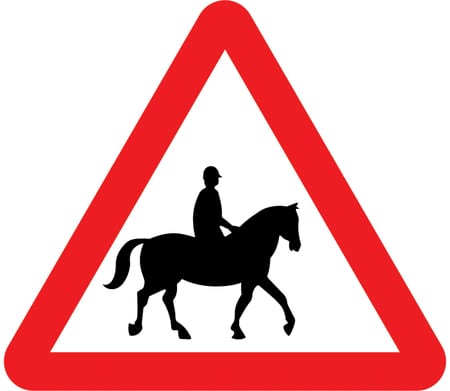
How should you pass a horse rider on the road?
- Under 10 mph, with at least 2 metres of space Right
- At 20 mph, with at least 1 metre
- Quickly, to get past
- With a short tap of the horn
The right answer is A: Under 10 mph, with at least 2 metres of space
WhyPass horse riders and horse-drawn vehicles at speeds under 10 mph and allow at least 2 metres of space.
Source: The Highway Code, rule 163, rule 215
-
Someone is walking in the road where there is no pavement. How should you pass them?
- At least 2 metres away and at a low speed Right
- At least half a metre away
- At normal speed, if you signal
- With a flash of your headlights
The right answer is A: At least 2 metres away and at a low speed
WhyAllow at least 2 metres of space and keep to a low speed when passing a pedestrian walking in the road. Wait behind if you cannot do so safely.
Source: The Highway Code, rule 163
Your first full mock test in the app is free.
Your topics
- Road and traffic signsKnow it
- Motorway rulesOn the way
- Vulnerable road usersStamped
In the app, questions you miss come back until you get them right. 5 questions a day are free.
62 free questions on this website and 372 in the app, checked against The Highway Code, with the reason for every answer. About the app
Out now on iPhone and Android.


47 more questions in the app
Practise free nowThe rule in plain words
Rule 163 says to give motorcyclists, cyclists, horse riders, horse-drawn vehicles and people walking in the road at least as much room as you would give a car when you overtake. It then gives distances as a guide. Give even more room in bad weather, in strong wind and at night. If you cannot leave that much space, stay behind until you can.
How much space to leave
| Who you are passing | Space and speed (rule 163, as a guide) |
|---|---|
| A cyclist, at up to 30 mph | At least 1.5 metres |
| A cyclist, above 30 mph | More than 1.5 metres |
| A horse rider or horse-drawn vehicle | At least 2 metres, at under 10 mph |
| Someone walking in the road | At least 2 metres, at a low speed |
| Any of them, in bad weather or at night | Extra care and more space |
| Not enough room to do this | Wait behind and do not overtake |
Try the free vulnerable road users quiz
Practise free nowWhat it means in practice
A cyclist on a narrow 30 mph road
A car coming towards you means you cannot leave 1.5 metres. Slow down and stay behind the cyclist until the oncoming car has passed and you can give the full space.
Two horses on a country lane
Slow to 10 mph or less as soon as you see them (rule 215). Do not rev or sound your horn. When it is safe, pass wide and slow with at least 2 metres to spare. Horses can startle and move very quickly.
Walking in the road where there is no pavement
Keep to a low speed and give at least 2 metres. Rule 206 adds: on narrow country roads without a pavement, slow down and be ready to stop.
A cyclist riding in the middle of the lane
Rule 213 says cyclists may ride in the centre of the lane on narrow roads, quiet streets, at junctions and in slow traffic, so they can see and be seen. Let them, and wait until you can pass with the full space.
Common mistakes
- Squeezing past because the gap is nearly big enough. 1.5 metres is the least you should leave at up to 30 mph, not a target.
- Keeping the same gap at 50 mph. The faster you go, the more room a cyclist needs.
- Passing a horse at normal speed. Under 10 mph, every time.
- Forgetting people walking in the road. They get the same 2 metres as horse riders.
- Overtaking a cyclist just before turning left. Stay behind and let them go first (rule H3).
Questions about passing distances
How much room do you have to give a cyclist in the UK?
The Highway Code’s guide is at least 1.5 metres when you overtake at speeds up to 30 mph, and more space at higher speeds. Source: rule 163.
How fast can you pass a horse?
Under 10 mph, with at least 2 metres of space. When you see a horse on the road, slow down to a maximum of 10 mph. Source: rules 163 and 215.
Can cyclists ride two abreast?
Yes. Rule 213 says it can be safer for groups of cyclists to ride two abreast on narrow roads, quiet streets, at junctions and in slower traffic. Source: rule 213.
What if I cannot leave enough space?
Wait behind and do not overtake until you can. Source: rule 163.
Read next
- Vulnerable road users quiz
- Vulnerable road users theory test questions
- Horse riders and animals: rules 214 and 215
- Cyclists and motorcyclists: rules 211 to 213
- Accompanied horses sign
Sources
(3)
- The Highway Code, rule 163 (overtaking), GOV.UK. Checked 4 November 2026.
- The Highway Code, rules 212 and 213 (motorcyclists and cyclists), GOV.UK. Checked 4 November 2026.
- The Highway Code, rule 215 (horse riders), GOV.UK. Checked 4 November 2026.
Contains public sector information licensed under the Open Government Licence v3.0. The sign image is Crown copyright. Sources and image credits.
Get the app free
Play with friends and family, and keep practising with every answer explained.