Moving off, mirrors and blind spots: rules 159 to 161
The short answer
Before you move off, check all your mirrors, look round over your shoulder for the blind spots, signal if needed and take a final look. Once moving, keep to the left and use your mirrors often, always before you signal or change speed or direction: mirrors, signal, manoeuvre.
Test yourself · 3
Three questions on moving off and keeping left
-
You are parked at the kerb and preparing to move off. All your mirrors show clear road. Why should you also look round before moving?
- Clear mirrors give you priority, and looking round confirms it
- Looking round is only needed when a mirror shows approaching traffic
- Looking round replaces the need to judge whether moving off is safe
- There are blind spots that your mirrors cannot show Right
The right answer is D: There are blind spots that your mirrors cannot show
WhyBefore moving off, look round to check blind spots as well as using all your mirrors.
Source: The Highway Code, rule 159
-
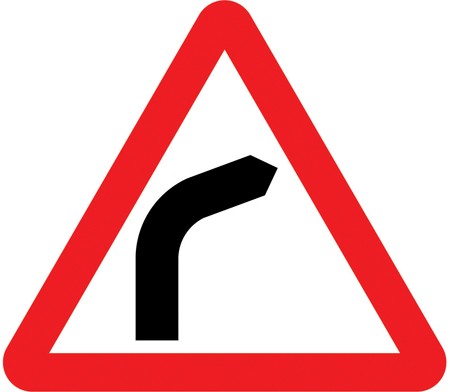
What does this sign mean?
- The road bends ahead, here to the right Right
- Do not overtake until the restriction ends
- The line nearer to you decides if you may cross
- The road surface ahead may be slippery
The right answer is A: The road bends ahead, here to the right
WhyBend ahead sign. The bend sign warns of a bend in the direction shown, here to the right. Slow down before it so you can stop within the distance you can see to be clear.
Source: The Highway Code, rule 125, GOV.UK, The Highway Code, rule 160, GOV.UK, The Highway Code, rule 166, GOV.UK, Know your traffic signs: warning signs, GOV.UK, Know your traffic signs: speed limit signs, GOV.UK, The Highway Code: traffic signs, GOV.UK, Traffic sign images, Department for Transport, GOV.UK
-
What does this sign mean?
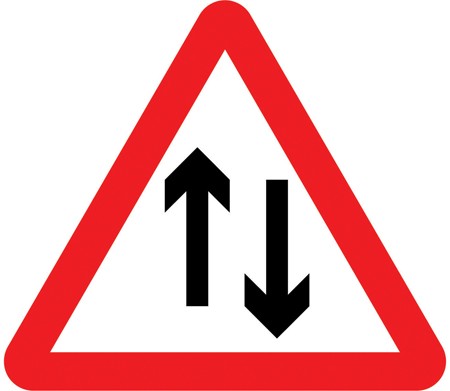
- Traffic ahead goes in both directions Right
- All traffic goes in the direction of the arrow
- Oncoming traffic goes first through the narrow part
- The line nearer to you decides if you may cross
The right answer is A: Traffic ahead goes in both directions
WhyTwo-way traffic sign. The two-way traffic sign warns that the road ahead carries traffic in both directions, for example where a one-way road or a dual carriageway ends.
Source: The Highway Code, rule 160, GOV.UK, Know your traffic signs: warning signs, GOV.UK, The Highway Code: traffic signs, GOV.UK, Traffic sign images, Department for Transport, GOV.UK
Your first full mock test in the app is free.
Your topics
- Road and traffic signsKnow it
- Motorway rulesOn the way
- Vulnerable road usersStamped
In the app, questions you miss come back until you get them right. 5 questions a day are free.
62 free questions on this website and 372 in the app, checked against The Highway Code, with the reason for every answer. About the app
Out now on iPhone and Android.


20 more questions in the app
Practise free nowThe rule in plain words
Moving off (rule 159). Check all your mirrors, then look round to check the blind spots, the areas your mirrors cannot show. Signal if necessary, take one last look round and only then pull away. In the Highway Code’s words: “Move off only when it is safe to do so.”
Once you are moving (rule 160). Keep to the left unless signs or markings say otherwise, or you are overtaking, turning right or passing parked cars or people in the road. Keep well to the left on right-hand bends, so you can see further and stay clear of oncoming traffic. Keep both hands on the wheel where you can. Watch for bikes filtering through traffic, and give way to cyclists when you change direction or lane. Change down a gear before a long downhill slope.
Mirrors (rule 161). Use your mirrors often so you always know what is behind and beside you, and use them in good time before you signal or change direction or speed. They do not show everything, so look round as well.
What rules 159 to 161 say
| Rule | What it means for you |
|---|---|
| 159 | Before moving off: all mirrors, look round for blind spots, signal if needed, final look round. |
| 160 | Keep left, keep well left on right-hand bends, both hands on the wheel where possible, look out for filtering bikes, lower gear before long downhills. |
| 160 | Towing: the extra length affects overtaking and the extra weight affects braking and speeding up. |
| 161 | Use mirrors often and before every signal or change of speed or direction. Remember the blind spots. |
Take the free practice quiz
Practise free nowWhat it means in practice
Pulling away from the kerb
Your mirrors look clear. Look round over your shoulder anyway: rule 159 says to check the blind spots, the areas your mirrors cannot show, and to take a final look before you go.
A right-hand bend on a country road
Keep well to the left. Rule 160 says this gives you a better view of the road and lowers the risk of hitting traffic coming the other way.
You want to change lane on a dual carriageway
Mirrors first, in good time, and a quick sideways look into the blind spot if needed, so you will not force anyone to slow down or swerve. Then signal, and move over when it is clear (rule 133).
Common mistakes
- Trusting the mirrors alone. Mirrors do not cover everything. Look round.
- Signalling before checking. Mirrors come first, then signal, then manoeuvre.
- Cutting a right-hand bend. Keep well to the left.
- Driving one-handed. Keep both hands on the wheel where possible.
Questions about moving off and mirrors
What is mirrors, signal, manoeuvre?
The order the Highway Code asks you to follow: check your mirrors, signal if needed, then make the move. Use your mirrors in good time before you signal or change direction or speed. Source: rule 161.
What is a blind spot?
An area around your car that your mirrors cannot show. Look round to check it before you move off or change lane. Source: rule 159.
Why keep left on a right-hand bend?
Rule 160 says it gives you a better view of the road and helps you avoid oncoming traffic. Source: rule 160.
Read next
- Alertness theory test questions
- Overtaking: rules 162 to 169
- Lanes, bus lanes and cycle lanes: rules 133 to 143
- Bend ahead sign and two-way traffic sign
Sources
(2)
- The Highway Code: using the road, general rules (rules 159 to 161), GOV.UK. Checked 4 November 2026.
- The Highway Code, rule 133 (changing lanes), GOV.UK. Checked 4 November 2026.
Contains public sector information licensed under the Open Government Licence v3.0. Quotes from The Highway Code and the sign image are Crown copyright. Sources and image credits.
Get the app free
Play with friends and family, and keep practising with every answer explained.