Driving in bad weather quiz
Seven questions on Highway Code rules 226 to 237: grip in heavy rain, ice and snow, bends on icy roads, and driving in fog.
Checked against GOV.UK · Report a mistake
Bad weather quiz
Pick an answer to see straight away if you’re right, with the reason and the rule it comes from. Your score shows at the end. Nothing is saved or sent anywhere.
-
During heavy rain, your steering becomes unresponsive as water prevents the tyres gripping the road. How should you reduce speed?
- Brake sharply to push the tyres through the water
- Ease off the accelerator and slow gradually Right
- Keep accelerating until the steering responds again
- Make repeated sharp turns while maintaining speed
The right answer is B: Ease off the accelerator and slow gradually
WhyIf water makes the steering unresponsive, ease off the accelerator and slow down gradually.
Source: The Highway Code, rule 227
-
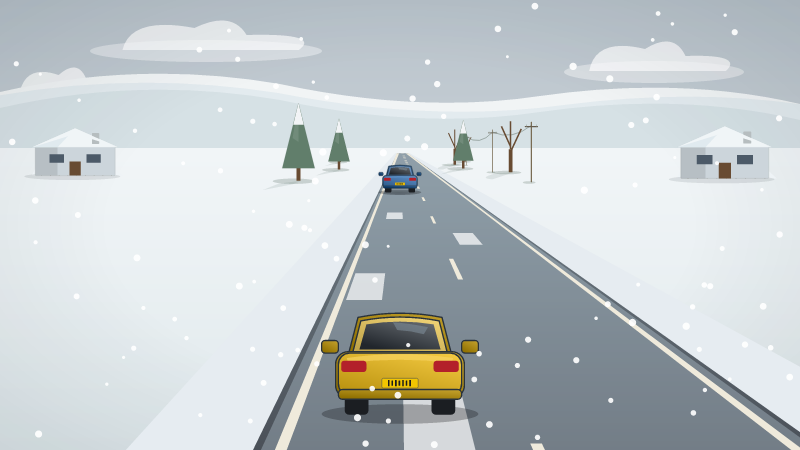
In icy or snowy weather, stopping distances can reach how many times the dry distance?
- Ten times Right
- Two times
- Three times
- Five times
The right answer is A: Ten times
WhyIn icy or snowy weather, stopping distances can be ten times greater than on dry roads.
Source: The Highway Code, rule 230
-
You are driving on a road that may be icy. Which of these is a sign that your vehicle is losing its grip on ice?
- The steering feels heavier and the tyres make more noise
- The steering responds normally and tyre noise increases
- The steering feels unresponsive and the tyres go quiet Right
- The tyres make a loud rumbling noise
The right answer is C: The steering feels unresponsive and the tyres go quiet
WhyRule 231: on ice the steering may feel unresponsive and tyres make almost no noise.
Source: The Highway Code, rule 231
-
You are on a straight stretch of icy road approaching a bend. You need to reduce speed before turning. Which approach should you use?
- Brake progressively on the straight, then steer smoothly Right
- Keep your speed on the straight, then brake firmly while turning
- Begin turning first, then use short bursts of heavy braking
- Accelerate towards the bend, then turn sharply through it
The right answer is A: Brake progressively on the straight, then steer smoothly
WhyOn ice, brake progressively before a bend, then steer smoothly and avoid sudden actions.
Source: The Highway Code, rule 231
-
In fog, you can see only a short stretch of clear road ahead. The rear lights of another car are visible farther away. What should determine your speed?
- Matching the speed of the visible rear lights
- Maintaining the speed you used before the fog
- Keeping close enough to follow the other car's lights
- Stopping well within the distance you see clearly Right
The right answer is D: Stopping well within the distance you see clearly
WhyIn fog, you should be able to stop well within the distance you can see clearly; rear lights can mislead.
Source: The Highway Code, rule 235
-
You are driving in fog and a vehicle is following too closely behind you. Which of these should you **not** do?
- Check your mirrors before you slow down
- Use your brake lights to warn when slowing down
- Keep a safe distance from the vehicle in front
- Accelerate to get away from it Right
The right answer is D: Accelerate to get away from it
WhyIn fog, do not accelerate to get away from a vehicle that is too close behind (rule 235).
Source: The Highway Code, rule 235
-
Fog has cleared and you can see clearly. What should you do with your fog lights?
- Leave them on to be seen
- Keep them on until you park
- Keep only the rear fog light on
- Switch them off Right
The right answer is D: Switch them off
WhyRule 236 says you must switch fog lights off when visibility improves.
Source: The Highway Code, rule 236
Your first full mock test in the app is free.
Your topics
- Road and traffic signsKnow it
- Motorway rulesOn the way
- Vulnerable road usersStamped
In the app, questions you miss come back until you get them right. 5 questions a day are free.
62 free questions on this website and 372 in the app, checked against The Highway Code, with the reason for every answer. About the app
Out now on iPhone and Android.


These are our own practice questions, drafted with AI help and checked against their cited sources. They are not questions from the DVSA theory test, and no driving instructor has reviewed them. How we write and check them.
How much longer it takes to stop
In wet weather, stopping distances will be at least double those on dry roads (rule 227). In icy or snowy weather they can be ten times greater (rule 230). Both checked 2 November 2026.
For any you got wrong, open the rule linked in the answer and read it once more. The Highway Code is one of the three books the theory test’s multiple-choice questions are based on (GOV.UK). Ready for more? Practise theory test questions by topic or take the 50-question timed practice quiz.
Keep going
- Read more: Stopping distances in the Highway Code
- Stopping distances quiz
- Speed limits quiz
- Christmas family driving quiz
Play it as a race
These questions work best out loud: one person reads, everyone else answers. In the Drivoku app the same kind of question appears on everyone’s phone at once, and faster right answers score more. How a Drivoku game works.
Sources
(6)
Source: The Highway Code on GOV.UK, checked 2 November 2026. Contains public sector information licensed under the Open Government Licence v3.0.