A quiz to play together, taking turns or on your own phones
Christmas family driving quiz
Twenty questions on winter roads and holiday journeys, for learners, new drivers and anyone who passed years ago. Free in your browser.
Checked against GOV.UK · Report a mistake
Play the 20 questions
Answer one question at a time. The reason appears straight after each answer, and nothing you pick is saved or sent anywhere.
Settings 20 questions · see the answer after each question
How many questions?
Changing a setting starts the round again.
-
Alertness
On a long drive, what minimum break is recommended after every two hours of driving?
- 15 minutes Right
- 5 minutes
- 10 minutes
- 30 minutes
The right answer is A: 15 minutes
WhyThe recommended minimum is a 15-minute break after every two hours of driving.
Source: The Highway Code, rule 91
-
Vehicle handling
You are on a straight stretch of icy road approaching a bend. You need to reduce speed before turning. Which approach should you use?
- Brake progressively on the straight, then steer smoothly Right
- Keep your speed on the straight, then brake firmly while turning
- Begin turning first, then use short bursts of heavy braking
- Accelerate towards the bend, then turn sharply through it
The right answer is A: Brake progressively on the straight, then steer smoothly
WhyOn ice, brake progressively before a bend, then steer smoothly and avoid sudden actions.
Source: The Highway Code, rule 231
-
Vulnerable road users
A Class 3 mobility scooter is travelling on the road at dusk. What should you remember?
- It is limited to 8 mph and may be hard to see Right
- It must not be used on the road after dusk
- It can keep up with the speed of traffic
- It has priority over your vehicle
The right answer is A: It is limited to 8 mph and may be hard to see
WhyA Class 3 mobility scooter is limited to 8 mph and may be hard to see, so allow for it.
Source: The Highway Code, rule 41, The Highway Code, rule 43
-
Hazard awareness
You are driving on a country road towards a turning that is partly hidden by hedges. Why should you reduce your speed?
- Farm vehicles may emerge, or there may be mud on the road Right
- Country roads have a 30 mph limit near every turning
- Traffic from hidden turnings always has priority
- You must stop and sound your horn at hidden turnings
The right answer is A: Farm vehicles may emerge, or there may be mud on the road
WhyOn country roads, slow down for partly hidden turnings and be ready for farm vehicles or mud on the road.
Source: The Highway Code, rule 154
-
Alertness
A driver passed their first driving test eight months ago. They are caught holding and using a phone to take a photograph while driving. Which outcome does GOV.UK describe for this offence?
- 6 penalty points, a £200 fine and loss of their licence Right
- 3 penalty points, a £200 fine and permission to keep their licence
- 6 penalty points and a £200 fine, with their licence kept for a first offence
- A £200 fine without points, since the phone was used only as a camera
The right answer is A: 6 penalty points, a £200 fine and loss of their licence
WhyHand-held phone use can bring 6 points and a £200 fine; drivers who passed in the last 2 years also lose their licence.
Source: GOV.UK: Using a phone, sat nav or other device when driving - Penalties
-
Vehicle loading
An 11-year-old child is 130 cm tall. You are taking them on a planned journey in your private car, with room for the correct child seat. What restraint must they use?
- An adult seat belt alone, because they are older than 3
- A suitable child car seat or booster seat Right
- An adult seat belt alone, because the journey is planned
- No restraint if an adult sits beside them in the rear
The right answer is B: A suitable child car seat or booster seat
WhyChildren normally need a child seat until age 12 or 135 cm tall, whichever comes first.
Source: GOV.UK: Child car seats: the law - Using a child car seat or booster seat
-
Attitude
You are in slow-moving traffic. What should you do to help an emergency vehicle get past?
- Move into the left lane to overtake
- Drive onto the hard shoulder
- Leave space so you can manoeuvre Right
- Pull close to the car in front
The right answer is C: Leave space so you can manoeuvre
WhyLeave enough space to manoeuvre if an emergency vehicle needs to get past.
Source: The Highway Code, rule 151
-
Safety and your vehicle
Fog has cleared and you can see clearly. What should you do with your fog lights?
- Leave them on to be seen
- Keep them on until you park
- Keep only the rear fog light on
- Switch them off Right
The right answer is D: Switch them off
WhyRule 236 says you must switch fog lights off when visibility improves.
Source: The Highway Code, rule 236
-
Vehicle loading
You need to take a 5-year-old child, 110 cm tall, on an unexpected, necessary journey over a short distance in your private car. The correct child seat is unavailable, but a rear seat has an adult belt. What does the stated exception allow?
- The child may use the adult belt on the rear seat Right
- The child may travel on the rear seat without any belt
- The child may share the driver's belt on the front seat
- The child may sit on an adult's lap without a belt
The right answer is A: The child may use the adult belt on the rear seat
WhyWith no suitable child seat, a child aged 3+ may use a rear adult belt on an unexpected, necessary, short trip.
Source: GOV.UK: Child car seats: the law - Unexpected journeys, GOV.UK: Seat belts: the law - Overview
-
Safety margins
In fog, you can see only a short stretch of clear road ahead. The rear lights of another car are visible farther away. What should determine your speed?
- Matching the speed of the visible rear lights
- Maintaining the speed you used before the fog
- Keeping close enough to follow the other car's lights
- Stopping well within the distance you see clearly Right
The right answer is D: Stopping well within the distance you see clearly
WhyIn fog, you should be able to stop well within the distance you can see clearly; rear lights can mislead.
Source: The Highway Code, rule 235
-
Alertness
Which of these does the Highway Code list as a distraction to avoid while driving?
- Listening for emergency sirens
- Glancing at your speedometer
- Eating or drinking Right
- Checking your mirrors
The right answer is C: Eating or drinking
WhyEating and drinking are distractions; keep your full attention on the road.
Source: The Highway Code, rule 148
-
Motorway rules
A passenger asks you to let them out on a motorway verge near a path. There is no emergency. How should you respond?
- Stop on the verge if the passenger can leave quickly
- Stop on the hard shoulder with your hazard lights on
- Continue without setting the passenger down Right
- Use an emergency area to let the passenger out
The right answer is C: Continue without setting the passenger down
WhyYou must not pick up or set down anyone on a motorway except in an emergency.
Source: The Highway Code, rule 272
-
Alertness
You drank alcohol last evening. What should you remember before driving this morning?
- A strong coffee makes you fit to drive
- Eating breakfast clears the alcohol
- A night's sleep always clears it
- You may still be unfit to drive Right
The right answer is D: You may still be unfit to drive
WhyAlcohol takes time to leave your body; drinking the evening before may leave you unfit to drive in the morning.
Source: The Highway Code, rule 95
-
Vehicle handling
You are driving in fog and a vehicle is following too closely behind you. Which of these should you **not** do?
- Check your mirrors before you slow down
- Use your brake lights to warn when slowing down
- Keep a safe distance from the vehicle in front
- Accelerate to get away from it Right
The right answer is D: Accelerate to get away from it
WhyIn fog, do not accelerate to get away from a vehicle that is too close behind (rule 235).
Source: The Highway Code, rule 235
-
Safety margins
You are driving on a road that may be icy. Which of these is a sign that your vehicle is losing its grip on ice?
- The steering feels heavier and the tyres make more noise
- The steering responds normally and tyre noise increases
- The steering feels unresponsive and the tyres go quiet Right
- The tyres make a loud rumbling noise
The right answer is C: The steering feels unresponsive and the tyres go quiet
WhyRule 231: on ice the steering may feel unresponsive and tyres make almost no noise.
Source: The Highway Code, rule 231
-
Safety margins
In icy or snowy weather, stopping distances can reach how many times the dry distance?
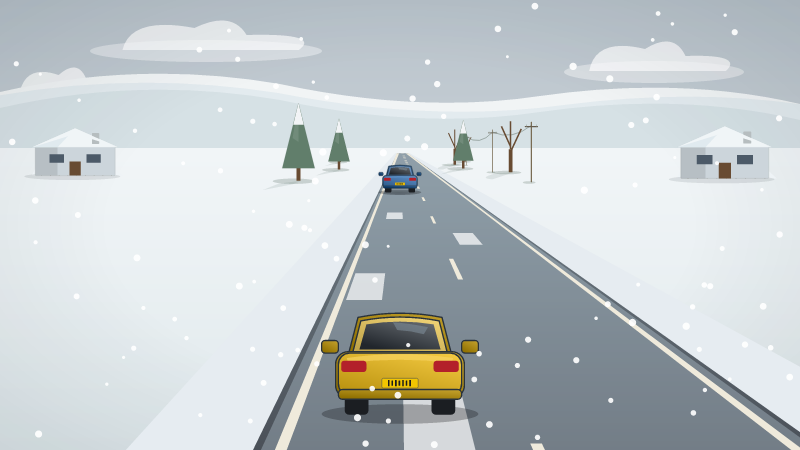
- Ten times Right
- Two times
- Three times
- Five times
The right answer is A: Ten times
WhyIn icy or snowy weather, stopping distances can be ten times greater than on dry roads.
Source: The Highway Code, rule 230
-
Incidents, accidents and emergencies
After a breakdown at night, which clothing does the Highway Code advise you to wear?
- Reflective clothing Right
- Dark clothing without reflective strips
- Any coat, whatever its visibility
- Fluorescent clothing without reflection
The right answer is A: Reflective clothing
WhyWear reflective clothing after a breakdown at night or in poor visibility.
Source: The Highway Code, rule 276
-
Vehicle loading
You join a motorway while towing a caravan with your car. No lower speed limit is displayed. What is the maximum speed allowed for your combination?
- 50 mph
- 60 mph Right
- 70 mph
- 30 mph
The right answer is B: 60 mph
WhyA car towing a caravan has a motorway speed limit of 60 mph.
-
Incidents, accidents and emergencies
A box falls from your car onto a motorway. You reach a place of relative safety. What should you do about the box?
- Wait for a gap, then walk back and collect it
- Leave it in place and call 999 Right
- Ask a passenger to retrieve it while you watch traffic
- Reverse along the motorway until you reach it
The right answer is B: Leave it in place and call 999
WhyLeave motorway obstructions for the emergency services; stop somewhere relatively safe and call 999.
Source: The Highway Code, rule 280, The Highway Code, rule 263
-
Safety margins
During heavy rain, your steering becomes unresponsive as water prevents the tyres gripping the road. How should you reduce speed?
- Brake sharply to push the tyres through the water
- Ease off the accelerator and slow gradually Right
- Keep accelerating until the steering responds again
- Make repeated sharp turns while maintaining speed
The right answer is B: Ease off the accelerator and slow gradually
WhyIf water makes the steering unresponsive, ease off the accelerator and slow down gradually.
Source: The Highway Code, rule 227
Topics to review
- Alertness
- Attitude
- Safety and your vehicle
- Safety margins
- Hazard awareness
- Vulnerable road users
- Other types of vehicle
- Vehicle handling
- Motorway rules
- Rules of the road
- Road and traffic signs
- Essential documents
- Incidents, accidents and emergencies
- Vehicle loading
- Regulatory signs
- Warning signs
- Information signs
- Road markings
Your first full mock test in the app is free.
Your topics
- Road and traffic signsKnow it
- Motorway rulesOn the way
- Vulnerable road usersStamped
In the app, questions you miss come back until you get them right. 5 questions a day are free.
20 questions in this test · 62 free questions on this website and 372 in the app, checked against The Highway Code, with the reason for every answer. About the app
Out now on iPhone and Android.


How to play it as a family
The UK web shows 62 of our 372 checked bank questions, with one free 50-question timed practice quiz and topic samples. The Drivoku app has all 372 questions.
Fifteen questions here also appear in the UK timed practice quiz; five are extra winter and holiday questions.
- Pick a quizmaster to read each question and its four answers aloud.
- Everyone else writes down A, B, C or D. The quizmaster taps an answer and reads out the reason.
- Keep score on paper: one point for each right answer.
- Or everyone takes the quiz on their own phone and you compare scores at the end.
A learner with the rules fresh in their head can beat someone who passed years ago. That is part of the fun.
Before a winter journey
- Plan a break of at least 15 minutes after every two hours of driving, and if you feel sleepy, stop somewhere safe, not on a hard shoulder or in an emergency area (rule 91).
- Alcohol from the night before can still leave you unfit to drive in the morning (rule 95).
- On ice and snow, stopping distances can be ten times greater than on dry roads (rule 230).
- Use dipped headlights in dull daytime weather, and switch fog lights off once you can see clearly again (rule 115, rule 236).
- Check tyre pressures when the tyres are cold, before you set off (Highway Code, Annex 6).
- After a breakdown at night, wear something reflective (rule 276).
Keep going
- One free timed practice quiz, with 50 questions.
- The printable theory test revision sheet.
- The Drivoku app hosts live quizzes like this one, with everyone answering on their own phone: how playing together works.
These are practice questions, not the real theory test. Drivoku covers the multiple-choice part only, not hazard perception.
Common questions
Is this quiz suitable for children?
Yes. There is no sign-up and there are no ads, and the questions are about staying safe on the road, so children can play along with a learner driver or a parent.
Do we need the app?
No. The quiz works in any browser, on a phone, a tablet or a laptop. The Drivoku app has live games where everyone answers on their own phone.
Are these real theory test questions?
No. They are our own practice questions written from The Highway Code and GOV.UK. The DVSA sets the real theory test, and its questions are not published.
Who wrote the questions?
We drafted them with AI help from The Highway Code and GOV.UK and checked each answer against the rule it cites. No driving instructor has reviewed them. Read how we make our questions.
Sources
(10)
- Child car seats: the law, GOV.UK
- Child car seats: when a child can travel without one, GOV.UK
- Seat belts: the law, GOV.UK
- The Highway Code: Breakdowns and incidents (275 to 287), GOV.UK
- The Highway Code: Driving in adverse weather conditions (226 to 237), GOV.UK
- The Highway Code: General rules, techniques and advice for all drivers and riders (103 to 158), GOV.UK
- The Highway Code: Motorways (253 to 274), GOV.UK
- The Highway Code: Rules for drivers and motorcyclists (89 to 102), GOV.UK
- The Highway Code: Rules for users of powered wheelchairs and mobility scooters (36 to 46), GOV.UK
- Using a phone, sat nav or other device when driving, GOV.UK
Contains public sector information licensed under the Open Government Licence v3.0.