Where not to park: Highway Code rules 238 to 247
The short answer
Do not park within 10 metres of a junction unless it is a marked bay, near a school entrance, at a bus stop or taxi rank, on a bend or near the brow of a hill, where you block a lowered kerb or a driveway, or where emergency services need to get through. You must not park on zig-zags, or on yellow lines when they apply.
Test yourself · 6
Six questions on parking rules
-
Which of these places does the Highway Code list as somewhere you should not stop or park?
- In a marked parking bay
- In an off-street car park
- At or near a taxi rank Right
- In a quiet lay-by
The right answer is C: At or near a taxi rank
WhyDo not stop or park at or near a taxi rank, except when forced to by stationary traffic.
Source: The Highway Code, rule 243
-
What do these markings mean?
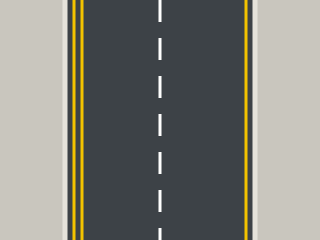
- No waiting or parking at the times shown
- No stopping at all, not even to drop off
- No parking, waiting or overtaking near a crossing
- Single and double yellow waiting restrictions Right
The right answer is D: Single and double yellow waiting restrictions
WhyYellow lines. Double yellow lines mean no waiting at any time. A single yellow line means no waiting during the times shown on nearby plates or zone signs.
Source: The Highway Code, rule 238, GOV.UK, The Highway Code: road markings, GOV.UK, Know your traffic signs: on-street parking control signs and road markings, GOV.UK
-
What does this sign mean?
- Single and double yellow waiting restrictions
- No waiting or parking at the times shown Right
- No parking, waiting or overtaking near a crossing
- No stopping at all, not even to drop off
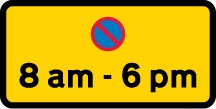
The right answer is B: No waiting or parking at the times shown
WhyNo waiting sign. The no waiting sign, a blue circle with a red ring and one red diagonal line, means you must not wait or park at the times shown on the plate.
Source: The Highway Code, rule 238, GOV.UK, The Highway Code: road markings, GOV.UK, Know your traffic signs: on-street parking control signs and road markings, GOV.UK, The Highway Code: traffic signs, GOV.UK, Traffic sign images, Department for Transport, GOV.UK
-
What does this sign mean?
- No stopping at all, not even to drop off Right
- Single and double yellow waiting restrictions
- No parking, waiting or overtaking near a crossing
- No waiting or parking at the times shown
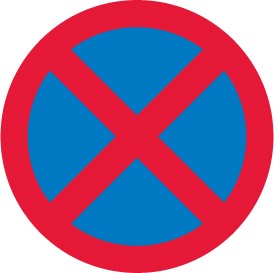
The right answer is A: No stopping at all, not even to drop off
WhyNo stopping (clearway) sign. The no stopping sign, a red cross on a blue circle, marks a clearway: you must not stop on the main carriageway, not even to pick up or set down passengers.
Source: The Highway Code, rule 240, GOV.UK, Know your traffic signs: on-street parking control signs and road markings, GOV.UK, The Highway Code: traffic signs, GOV.UK, Traffic sign images, Department for Transport, GOV.UK
-
On a road that is not a red route, a single yellow line and yellow kerb marks are accompanied by a plate prohibiting waiting and loading at the current time. There are no other restrictions and stopping would cause no danger or obstruction. What may you stop to do?
- Unload a heavy box
- Wait for a passenger to arrive
- Let a passenger get out Right
- Load a pre-paid purchase
The right answer is C: Let a passenger get out
WhyWaiting and loading restrictions still allow stopping while passengers board or alight.
Source: The Highway Code: Road markings, Know Your Traffic Signs: On-street parking control signs and road markings
-
A passenger is ready to leave your car outside a school. Yellow zig-zags mark the entrance, and an upright sign prohibits stopping there during the current period. Where should you set the passenger down?
- On the zig-zags while the engine runs
- On the zig-zags if the passenger is ready
- On the zig-zags for a brief drop-off
- At another place where stopping is allowed Right
The right answer is D: At another place where stopping is allowed
WhyDuring the signed restriction, stopping on school entrance zig-zags is banned, including passenger drop-offs.
Source: Know Your Traffic Signs: On-street parking control signs and road markings, The Highway Code, rule 238
Your first full mock test in the app is free.
Your topics
- Road and traffic signsKnow it
- Motorway rulesOn the way
- Vulnerable road usersStamped
In the app, questions you miss come back until you get them right. 5 questions a day are free.
62 free questions on this website and 372 in the app, checked against The Highway Code, with the reason for every answer. About the app
Out now on iPhone and Android.


31 more questions in the app
Practise free nowThe rule in plain words
Lines and markings (rule 238). You must not wait or park on yellow lines during the times shown on the nearby plates. Double yellow lines mean no waiting at any time, even without a sign. On school entrance zig-zags you must not stop, even to drop someone off, when an upright sign bans stopping.
Where you must not stop or park (rules 240 and 241). These include a motorway, except in an emergency, a pedestrian crossing and its zig-zags, a clearway, taxi bays, a cycle track, a cycle or tram lane during its hours, and spaces kept for Blue Badge holders or residents unless you are allowed to use them.
Where you should not stop or park (rule 243). Near a school entrance; where emergency services would be blocked; at or near a bus or tram stop or taxi rank; on the approach to a level crossing; opposite or within 10 metres of a junction, except in a marked bay; near the brow of a hill or a hump bridge; opposite a traffic island; on a bend; across a lowered kerb or in front of someone’s entrance; or where you would block cyclists. In the Highway Code’s words, the exception is “when forced to do so by stationary traffic”.
What rules 238 to 247 say
| Rule | What it means for you |
|---|---|
| 238 | No waiting or parking on yellow lines when they apply. Double yellow lines: no waiting at any time. |
| 239 | Use car parks or marked bays if you can. Park close to the side, not facing the traffic. Switch off the engine, headlights and fog lights, apply the handbrake, and check for cyclists before opening your door. |
| 240 | You must not stop or park on a motorway (except in an emergency), a crossing or its zig-zags, a clearway, taxi bays, a road with double white lines (except to pick up, set down or load), a cycle track, or a cycle or tram lane in its hours. |
| 241 | You must not use spaces kept for Blue Badge holders, residents or motorcycles unless you are entitled to. |
| 242 | You must not leave your car where it is dangerous or blocks the road for no good reason. |
| 243 | Do not stop or park near school entrances, at bus stops or taxi ranks, within 10 metres of a junction (except in an authorised space), on bends, near the brow of a hill, or across a lowered kerb or entrance. |
| 244 | You must not park on the pavement in London or Scotland. Elsewhere, do not, unless signs allow it. |
| 245 | In a Controlled Parking Zone, the signs where you enter show when the restrictions apply. |
| 247 | Do not load or unload where yellow kerb marks and signs say it is not allowed. |
Try the free road markings and box junctions quiz
Practise free nowWhat it means in practice
A single yellow line with a time plate
Read the plate. During the times shown you must not wait or park there. Outside them you may, unless other signs say otherwise. Yellow marks on the kerb with a sign mean loading is restricted too.
Dropping a child at school
If yellow zig-zags mark the school entrance and an upright sign bans stopping, find another place where you may stop, even if it is only for a moment (rule 238).
A space right on the corner
Within 10 metres (32 feet) of a junction you should not park unless it is a marked bay.
Common mistakes
- Thinking double yellow lines need a sign. They mean no waiting at any time, sign or not.
- Stopping on zig-zags for just a second. You must not stop on a crossing’s zig-zags at all.
- Parking half on the pavement. In London and Scotland it is against the law, with limited exceptions. Elsewhere, only where signs allow it.
- Blocking a lowered kerb. It is there to help wheelchair and mobility scooter users.
- Flinging the door open. Check for cyclists first. Opening with your far hand makes you look over your shoulder (rule 239).
Questions about parking rules
What is rule 243 of the Highway Code?
It lists places where you should not stop or park, such as near a school entrance, at a bus stop or taxi rank, within 10 metres of a junction, on a bend, and across a lowered kerb, unless stationary traffic forces you to. Source: rule 243.
How close to a junction can you park?
Not opposite or within 10 metres (32 feet) of a junction, except in an authorised parking space. Source: rule 243.
Can you park on double yellow lines?
No. Double yellow lines mean no waiting at any time, even if there are no upright signs. Source: rule 238.
Is it illegal to park on the pavement?
In London and Scotland, yes, with limited exceptions. Elsewhere the Highway Code says you should not, unless signs allow it. Source: rule 244.
Read next
- Rules of the road theory test questions
- Yellow lines: what they mean and zig-zag lines
- No waiting sign and no stopping sign
- Road markings and box junctions quiz
Sources
(2)
- The Highway Code: waiting and parking (rules 238 to 252), GOV.UK. Checked 4 November 2026.
- The Highway Code, rule 243, GOV.UK. Checked 4 November 2026.
Contains public sector information licensed under the Open Government Licence v3.0. Quotes from The Highway Code and the sign image are Crown copyright. Sources and image credits.
Get the app free
Play with friends and family, and keep practising with every answer explained.