Separated cycle and pedestrian route sign: what it means
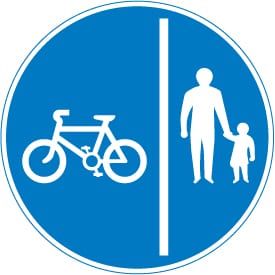
This blue sign means the route has a separate track for cycles and a separate path for pedestrians, side by side. Each keeps to its own side, as the sign shows.
What does the separated cycle and pedestrian route sign mean?
Know your traffic signs describes it as a separated track and path for pedal cycles and pedestrians. The two sides may be split by a white line, a kerb, a verge or a change of surface. Cyclists must keep to the side intended for them, because the pedestrian side remains a pavement or footpath (rule 62).
Quick quiz
What does the sign at the top of this page mean?
- Cyclists on one side, pedestrians on the other.
- Cyclists and pedestrians share one path.
- A route only for pedal cycles.
Show answer
A. Cyclists on one side, pedestrians on the other. A separated track and path: cycles keep to one side and pedestrians to the other (Know your traffic signs). Source: Know your traffic signs: bus and cycle signs and road markings, GOV.UK; The Highway Code, rule 62, GOV.UK; The Highway Code, rule 13, GOV.UK; Traffic sign images, Department for Transport, GOV.UK
Where will you see it?
Beside main roads and on wide paths in towns, where there is room for both a cycle track and a footway.
What should you do?
Keep to your side: the sign shows which side is which. Pedestrians who need to cross the cycle side should look for cyclists first. Drivers: do not drive or park on it.
What do people get wrong?
Walking on the cycle side because it is clearer. The side with the cycle symbol is a cycle track.
Common questions
Which side is for cycles?
The side shown with the bicycle symbol on the sign. Road markings on the path usually repeat it.
Can the sign be mirrored?
Yes. The cycle and pedestrian symbols can be on either side, to match the layout of the path.
Compare with
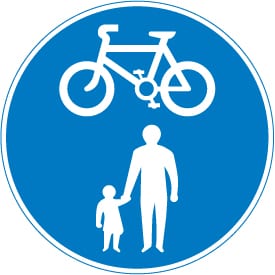 Shared route for cycles and pedestrians signCyclists and pedestrians share one path.
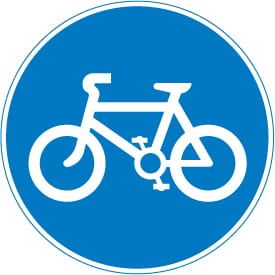 Route for cycles only signA route only for pedal cycles.
Want to test someone else? Play a road-sign quiz with friends and family.
Sources
Checked on 3 November 2026 against Know your traffic signs (bus and cycle signs and road markings) and The Highway Code rules 13 and 62.
- Know your traffic signs: bus and cycle signs and road markings, GOV.UK
- The Highway Code, rule 62, GOV.UK
- The Highway Code, rule 13, GOV.UK
- Traffic sign images, Department for Transport, GOV.UK
Contains public sector information licensed under the Open Government Licence v3.0. Traffic sign images are Crown copyright, from the Department for Transport. Sources and image credits.