Junctions: Highway Code rules 170 to 183
The short answer
Rule 170 says take extra care at junctions: look out for cyclists, motorcyclists and people on foot, give way to anyone crossing or waiting to cross the road you are turning into or out of, and only pull out when the gap is big enough to do it safely.
Test yourself · 6
Six questions on junction rules 170 to 183
-
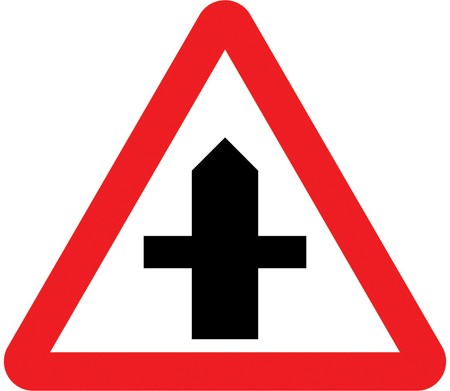
What does this sign mean?
- Stop completely at the line, then give way
- Your road ends at a T-junction ahead
- A crossroads is ahead Right
- Let traffic on the major road go first
The right answer is C: A crossroads is ahead
WhyCrossroads sign. The crossroads sign warns that a crossroads is ahead. The broader line on the sign shows which road has priority through the junction.
Source: The Highway Code, rule 170, GOV.UK, Know your traffic signs: warning signs, GOV.UK, The Highway Code: traffic signs, GOV.UK, Traffic sign images, Department for Transport, GOV.UK
-
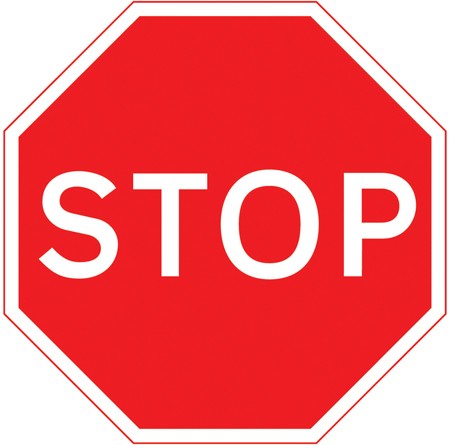
You are approaching a junction with a 'STOP' sign and a solid white line across the road. What must you do before you enter the major road?
- Slow down and drive out if nothing is coming
- Stop only if there is traffic on the major road
- Stop at the line and wait until the way is clear Right
- Treat it the same as a give way sign
The right answer is C: Stop at the line and wait until the way is clear
WhyAt a STOP sign you must stop at the line and only go when the way is clear.
-
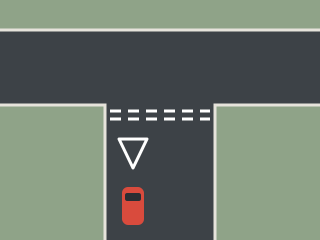
What do these markings mean?
- Let traffic on the major road go first
- Double broken white lines across a junction Right
- Give way to traffic from your immediate right
- Stop completely at the line, then give way
The right answer is B: Double broken white lines across a junction
WhyGive way lines. Give way lines, two rows of broken white lines across the end of a road, mean you must give way to traffic on the main road. A white triangle before them warns they are just ahead.
Source: The Highway Code, rule 172, GOV.UK, The Highway Code: road markings, GOV.UK, Know your traffic signs: regulatory signs, GOV.UK
-
You want to cross a dual carriageway. Its central reservation is too shallow to shelter the full length of your car. Traffic on the nearer carriageway clears, but traffic continues on the farther one. What should you do?
- Wait for a safe gap across both carriageways Right
- Cross halfway and wait with the rear of your car protruding
- Enter the reservation and ask farther traffic to let you out
- Cross the nearer carriageway and edge into the farther one
The right answer is A: Wait for a safe gap across both carriageways
WhyIf the central reservation cannot shelter your full vehicle, wait until you can cross both carriageways in one go.
Source: The Highway Code, rule 173
-
You are waiting to turn left. The signals controlling your lane show a red light and an illuminated green left arrow. The route to your left is clear. What may you do?
- Turn left Right
- Proceed straight ahead instead
- Turn right if that route is clear
- Move only when the full green appears
The right answer is A: Turn left
WhyA green arrow permits travel in its direction when clear, even while other lights show red.
-
You are about to turn left into a side road. How should you position your car as you make the turn?
- In the middle of your side of the road
- Swing out to the right before the turn
- As close to the left as is safe and practicable Right
- Towards the centre line until you reach the turn
The right answer is C: As close to the left as is safe and practicable
WhyWhen turning left, keep as close to the left as is safe and practicable.
Source: The Highway Code, rule 183
Your first full mock test in the app is free.
Your topics
- Road and traffic signsKnow it
- Motorway rulesOn the way
- Vulnerable road usersStamped
In the app, questions you miss come back until you get them right. 5 questions a day are free.
62 free questions on this website and 372 in the app, checked against The Highway Code, with the reason for every answer. About the app
Out now on iPhone and Android.


30 more questions in the app
Practise free nowThe rule in plain words
Rule 170 is the general rule for every junction: slow down, look properly and do not assume. Cyclists, motorcyclists and people using mobility scooters are easy to miss. Give way to people crossing or waiting to cross the road you are turning into or out of; once they have started to cross, they have priority. A car signalling left may not actually turn, so wait until you are sure. In the Highway Code’s words, you should “look all around before emerging”.
The rules after it cover the different kinds of junction: STOP and give way lines (171 and 172), crossing a dual carriageway (173), box junctions (174), traffic lights (175 to 178), turning right (179 to 181) and turning left (182 and 183).
What rules 170 to 183 say
| Rule | What it means for you |
|---|---|
| 170 | Take extra care. Give way to people crossing or waiting to cross, stay behind cyclists and riders at the junction, and wait for a safe gap. |
| 171 | At a STOP sign with a solid white line you must stop behind the line, then wait for a safe gap. |
| 172 | At broken white lines across the road you must give way to traffic on the main road. |
| 173 | Crossing a dual carriageway: wait in the middle only if the gap there is deep enough for your whole vehicle. If not, cross both halves in one go. |
| 174 | Yellow box: do not enter until your exit is clear, unless you are turning right and only oncoming traffic or other cars turning right are stopping you. At signalled roundabouts, only enter if you can cross the box without stopping. |
| 175 to 176 | Stop at the white line unless the light is green. On amber, go on only if you are over the line or too close to stop safely. |
| 177 | A green filter arrow lets you go in the arrow’s direction, even while the main light is red. |
| 178 | At an advanced stop line for cyclists, stop at the first white line when the lights are amber or red. |
| 179 to 181 | Turning right: mirrors, signal, position just left of the middle of the road, then wait for a safe gap. Do not cut the corner. |
| 182 to 183 | Turning left: signal early, do not overtake just before the turn, keep close to the left and give way to bus and cycle lanes. |
Try the free road markings and box junctions quiz
Practise free nowWhat it means in practice
Pulling out of a side road
You stop at the give way lines, but a van parked near the junction blocks your view to the right. Do not pull out until you can see properly. Rule 170 says to look all around before you emerge, and rule 211 warns that motorcyclists and cyclists may be coming faster than you think.
Turning right at traffic lights
The light is green and you move forward to wait just left of the middle of the junction. You wait there for a safe gap in the oncoming traffic. Rule 176 allows this: you may go forward on green to take up a position to turn right.
Two cars turning right at crossroads
You and an oncoming car both want to turn right. Rule 181 gives two ways to do it. Turning right side to right side, so that you pass behind each other, is generally safer because you can see the traffic coming towards you as you turn.
Common mistakes
- Rolling through a STOP sign. You must stop behind the line every time, even when the road looks empty.
- Trusting a left signal. The car coming from the right may go straight on. Wait until it starts to turn.
- Entering a yellow box because the light is green. If your exit is blocked, wait behind the box.
- Cutting in on a cyclist when turning left. Do not overtake a cyclist just before you turn left. Stay behind and let them go first.
- Stopping half-way on a narrow central reservation. If your car sticks out into the far lane, cross both halves in one go instead.
Questions about junction rules
What is rule 170 of the Highway Code?
It is the general rule for junctions: take extra care, watch for cyclists, motorcyclists and pedestrians, give way to people crossing or waiting to cross the road you turn into or out of, do not trust a left signal, and look all around before you pull out. Source: rule 170.
Do I have to stop at a give way line?
Not always. You must give way to traffic on the main road, which may mean stopping. At a STOP sign with a solid white line you must always stop. Source: rules 171 and 172.
Can I go on amber at traffic lights?
Only if you have already crossed the stop line, or you are so close that stopping might cause a crash. Otherwise amber means stop. Source: rule 175.
When can I wait in a yellow box junction?
When you want to turn right and the only thing stopping you is oncoming traffic, or other cars waiting to turn right. In every other case, wait until your exit is clear. At a roundabout with traffic lights, you must not enter the box unless you can cross it completely without stopping. Source: rule 174.
Read next
- Rules of the road theory test questions
- Yellow box junction: what it means
- Stop sign and give way sign
- The hierarchy of road users: rules H1 to H3
- Roundabouts: rules 184 to 190
Sources
(3)
- The Highway Code: road junctions (rules 170 to 183), GOV.UK. Checked 4 November 2026.
- The Highway Code, rule 170, GOV.UK. Checked 4 November 2026.
- The Highway Code, rule 181 (two cars turning right), GOV.UK. Checked 4 November 2026.
Contains public sector information licensed under the Open Government Licence v3.0. Quotes from The Highway Code and the sign image are Crown copyright. Sources and image credits.
Get the app free
Play with friends and family, and keep practising with every answer explained.