The Virginia permit test, explained
The short answer
The Virginia knowledge exam has two parts. Part one has 10 road sign questions, and you must get all 10 right. Part two has 30 general knowledge questions, and you need 24 right. You can apply for a learner’s permit from 15 years and 6 months.
Source: The knowledge exam, Virginia DMV
In Virginia one wrong road sign answer fails the sign part, so learn every sign until you know it on sight.
This text was written with AI help, checked against the Virginia DMV’s pages and approved by Fri Vei AS. Last updated .
Checked against the Virginia DMV · Report a mistake
Drivoku is not connected to the Virginia Department of Motor Vehicles (DMV). Every fact below links to the DMV page it comes from, checked on November 3, 2026.
The Virginia permit test at a glance
| Minimum age | 15 years and 6 months (DMV) |
|---|---|
| Part one | 10 road sign questions; all 10 must be right (DMV) |
| Part two | 30 general knowledge questions; 24 must be right |
| Where | On a computer at a DMV customer service center, or in class at participating high schools; oral exams on request at DMV centers |
| If you fail (under 18) | Wait a full 15 days before you retake it |
| Fee | $3 for the learner’s permit, plus the yearly cost of the driver’s license (DMV) |
| Supervisor | A licensed driver aged 21 or older beside you, or 18 or older if a legal guardian or sibling |
How many questions are on the Virginia permit test?
Forty, in two parts (Virginia DMV: the knowledge exam):
- Part one, road signs: 10 questions, and all 10 must be right.
- Part two, general knowledge: 30 questions, and you need 24 right, so you can miss 6.
You can take the exam on a computer at a DMV customer service center, or in a classroom at a participating high school. The exam is offered in many languages, including American Sign Language. If you are under 18 and fail, you must wait a full 15 days before you can take it again.
What to bring
From the DMV page on applying for a learner’s permit:
- The Application for a Virginia Driver’s License (DL 1P), signed by a parent or legal guardian if you are under 18.
- Proof of identity and legal presence, two proofs of Virginia residency, and your Social Security number if you have one.
- The $3 permit fee plus the yearly cost of the license (the DMV’s fee chart has the amounts).
At your appointment you also take a vision screening.
Rules for teen drivers in Virginia
Virginia, like every state, uses graduated driver licensing. From the learner’s permit page:
- Until you meet the rules for driving alone (last point below), drive with a licensed driver beside you who is at least 21, or at least 18 if they are your legal guardian or sibling.
- Under 18, hold the permit for at least nine months before you can get a driver’s license.
- A parent or guardian must certify that you have driven at least 45 hours, 15 of them after sunset.
- To drive without a supervisor you need a signed Virginia Driver Training Certificate, to be at least 16 years and 3 months old, and to have held the permit for nine months.
What Drivoku covers for Virginia
Signs are the part of the Virginia exam with no room for mistakes, and signs are national: they follow the same sign manual in every state. Our road signs library and road signs quiz cover 31 signs and markings, and the permit practice test covers road rules every state shares. Virginia’s own laws are not in our questions, so read the Virginia Driver’s Manual for part two.
Practice five questions every state shares
Five shared signs and rules
Answer one question at a time. You see the answer and the reason after each one. Nothing you pick is saved or sent anywhere.
-
Signs
A white sign reads DO NOT PASS. What does it mean?
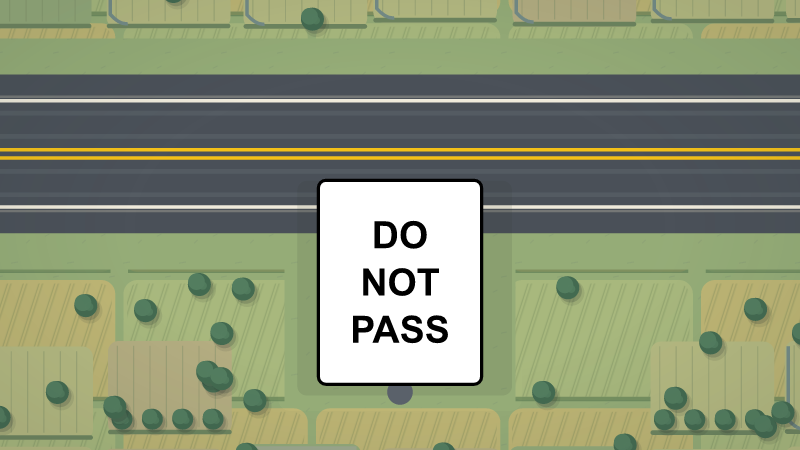
- Do not overtake other vehicles Right
- Do not park on the shoulder
- Do not turn left here
- Do not follow too closely
The right answer is A: Do not overtake other vehicles
WhyDO NOT PASS means you may not overtake another vehicle in that zone.
-
Pavement markings
A white arrow painted in your lane curves left. What does it tell you?
- Left turns are forbidden here
- This lane is for left turns Right
- The road curves left up ahead
- You may turn left or go straight
The right answer is B: This lane is for left turns
WhyA lane-use arrow shows the movements allowed or required in that lane.
-
Signs
A green rectangular sign has white lettering reading CIVIC CENTER and a white arrow pointing right. What information does it provide?
- A requirement for every vehicle to turn right
- A warning that the road bends sharply right
- Permission to turn right without checking traffic
- Directions to the civic center Right
The right answer is D: Directions to the civic center
WhyGreen guide signs provide direction guidance to destinations.
Source: MUTCD Section 1D.05 Color Code
-
Traffic signals
A steady yellow left-turn arrow is showing. What does it tell you?
- The left-turn movement is ending; prepare to stop Right
- You now have the right-of-way to turn
- Left turns are now forbidden
- The arrow is about to turn green
The right answer is A: The left-turn movement is ending; prepare to stop
WhyA steady yellow arrow warns that the current left-turn movement is ending; prepare to stop.
Source: MUTCD Section 4A.03 Meanings of Steady Vehicular Signal Indications
-
Passing
You want to pass a slow truck on a two-lane road, but you are nearing a hill crest where you cannot see oncoming traffic. What should you do?
- Wait until you can see far enough to pass Right
- Pass quickly before you reach the crest
- Pass on the right shoulder instead
- Follow close behind and pass at the crest
The right answer is A: Wait until you can see far enough to pass
WhyDo not pass where your view is blocked, such as near a hill crest, curve, intersection, or crossing.
Source: UVC § 11-306(a)(1) Further limitations on driving on left of center of roadway (model law)
Topics to review
- Signs
- Traffic signals
- Pavement markings
- Intersections and turns
- Right-of-way
- Sharing the road
- Alcohol and drugs
- Speed and space
- Seat belts and child safety
- Night and bad weather
- Distraction
- Emergencies
- Lanes
- Passing
- Highways
- Regulatory signs
- Warning signs
- Guide and service signs
- Pavement markings
- Emergency vehicles and crashes
- Learner and provisional licenses
- Driver education
- Seat belts and child seats
- Alcohol and DWI
- Parking
- Speed limits
- Sharing the road
- Headlights
- Insurance
- Phones and distraction
Your topics
- SignsKnow it
- Learner and provisional licensesOn the way
- Right-of-wayStamped
In the app, questions you miss come back until you get them right. 5 questions a day are free.
45 free questions on this website and 379 in the app, checked against the MUTCD, the Uniform Vehicle Code and Texas law, with the reason for every answer. About the app
Out now on iPhone and Android.


Start with US road sign shapes and colors if signs are new to you. Other states: permit test by state.
Common questions
How many questions can you miss on the Virginia permit test?
None of the 10 road sign questions, and up to 6 of the 30 general knowledge questions.
How old do you have to be to get a learner’s permit in Virginia?
At least 15 years and 6 months.
How long do you wait after failing the Virginia permit test?
If you are under 18, a full 15 days.
Can you take the Virginia permit test at school?
At participating high schools, yes: the DMV says the exam is also given in classrooms there. Otherwise you take it on a computer at a DMV customer service center.