US road sign shapes and colors
Many US road signs tell you what they mean before you can read them. The shape and the color are the clues.
This text was written with AI help, checked against the MUTCD and approved by Fri Vei AS. Last updated .
Last checked against the sources: · Report a mistake
Contents
One national sign manual
US road signs follow the Manual on Uniform Traffic Control Devices (MUTCD), published by the Federal Highway Administration. It is the national standard for traffic signs on roads open to public travel. States either use it as it is, add a state supplement, or publish a state version that must closely match it (“substantial conformance”, in FHWA’s words). That is why sign shapes and colors are the same in every state, even though each state writes its own permit test.
Shapes that belong to one sign
The MUTCD keeps some shapes for one sign only, so the shape alone tells you which sign it is. It even says these shapes should not be hidden by another sign mounted on the back.
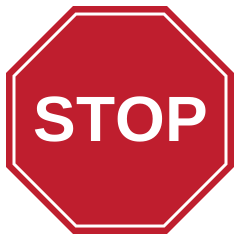
Octagon: STOP 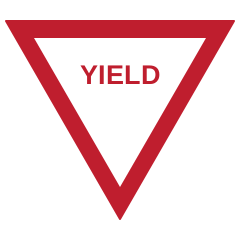
Triangle down: YIELD 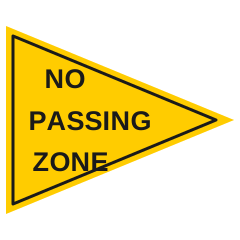
Pennant: NO PASSING ZONE 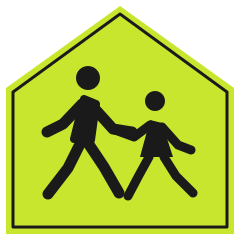
Pentagon: school 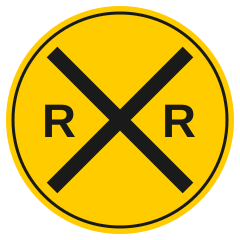
Circle: railroad ahead
- Octagon (eight sides): STOP, and only STOP.
- Triangle pointing down: YIELD.
- Pennant (a long triangle pointing right): NO PASSING ZONE.
- Pentagon (five sides, pointing up): school sign. County route markers use a pentagon with tapered sides.
Two more shapes are kept for railroad crossings: a circle warns that a railroad crossing (a “grade crossing”) is ahead, and the crossbuck (an X) marks the crossing itself.
Shapes used for groups of signs
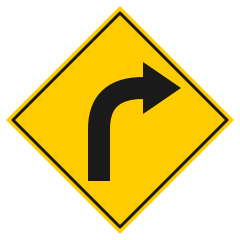
Diamond: a warning 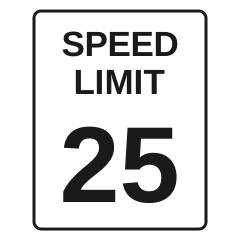
Rectangle: a rule 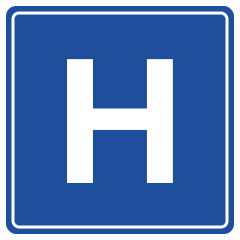
Square: a service
- Diamond: warning signs, such as a curve or an intersection ahead.
- Rectangle (including squares): regulatory signs like SPEED LIMIT, guide signs, and some warning signs.
What the colors mean
| Color | General meaning |
|---|---|
| Red | Stop or prohibition |
| Yellow | Warning |
| White and black | Regulation |
| Orange | Temporary traffic control, such as work zones |
| Fluorescent yellow-green | Pedestrian, bicycle, playground, school bus and school warnings |
| Green | Movements that are allowed, and direction guidance |
| Blue | Road user services, tourist information and evacuation routes |
| Brown | Recreational and cultural interest areas, such as parks |
| Fluorescent pink | Incident management |
| Purple | Lanes only for vehicles with a registered electronic toll account |
These are general meanings. Each sign also has its own words or symbol, so read the whole sign.
A way to practice
When you’re a passenger, call out each sign’s shape and color before you can read it, then guess what it says. It turns any drive into a quiz.
Quick check
Which shape is used only for STOP signs?
- Diamond
- Octagon
- Circle
Show answer
B. Octagon. The octagon is reserved for STOP. Source: MUTCD 11th Edition, Chapter 2A (Section 2A.05 Shapes, Table 2A-1), FHWA
What does a pennant-shaped sign mean?
- School
- No passing zone
- Rest area
Show answer
B. No passing zone. The pennant is used only for NO PASSING ZONE. Source: MUTCD 11th Edition, Chapter 2A (Section 2A.05 Shapes, Table 2A-1), FHWA
What does orange mean on a sign?
- Temporary traffic control
- Recreation area
- Evacuation route
Show answer
A. Temporary traffic control. Orange is for temporary traffic control, such as work zones. Source: MUTCD 11th Edition, Part 1 (Section 1D.05 Color Code), FHWA
Sources
(4)
- MUTCD 11th Edition, Chapter 2A (Section 2A.05 Shapes, Table 2A-1), FHWA
- MUTCD 11th Edition, Part 1 (Section 1D.05 Color Code), FHWA
- MUTCD 11th Edition, FHWA. FHWA lists the current version as the 11th Edition with Revision 1, dated December 2025
- State MUTCD information, FHWA