Do not drive on tracks sign: what it means
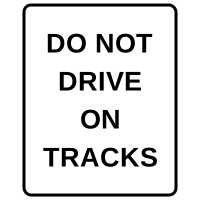
The DO NOT DRIVE ON TRACKS sign means you must not drive on the light rail trackway beside or between traffic lanes.
What does the DO NOT DRIVE ON TRACKS sign mean?
MUTCD Section 8B.14 says a No Motor Vehicles On Tracks sign may be used to deter drivers from driving on the trackway, and the word sign DO NOT DRIVE ON TRACKS (R15-6a) may be used instead of the symbol sign.
Quick quiz
What does the sign at the top of this page mean?
- Never stop on the railroad tracks.
- Do not drive on the light rail tracks.
- Traffic comes toward you here; do not go in.
Show answer
B. Do not drive on the light rail tracks. It deters motor vehicles from driving on the trackway (MUTCD Section 8B.14). Source: MUTCD 11th Edition, Part 8, Traffic Control for Railroad and Light Rail Transit Grade Crossings: Section 8B.14, FHWA; MUTCD 11th Edition, FHWA
Where will you see it?
On streets with light rail, beside or between the tracks.
What should you do?
Keep to the traffic lanes and cross the tracks only where allowed.
What do people get wrong?
Using the tracks as an extra lane in slow traffic.
Common questions
Is there a symbol version?
Yes. The R15-6 sign shows a car on tracks in a red circle with a slash.
Why not drive on the tracks?
Trains use them and cannot steer around you.
Compare with
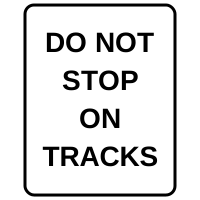 Do not stop on tracks signNever stop on the railroad tracks.
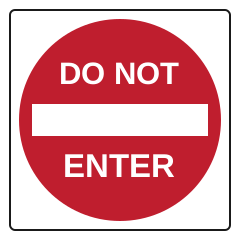 Do not enter signTraffic comes toward you here; do not go in.
Want to test someone else? Play a road-sign quiz with friends and family.
Sources
Checked on 4 November 2026 against the MUTCD 11th Edition (FHWA), Section 8B.14.
- MUTCD 11th Edition, Part 8, Traffic Control for Railroad and Light Rail Transit Grade Crossings: Section 8B.14, FHWA
- MUTCD 11th Edition, FHWA. FHWA lists the current version as the 11th Edition with Revision 1, dated December 2025
Sign pictures are our own simplified drawings of the MUTCD designs, which are in the public domain (MUTCD Section 1D.06). Sources and image credits.