The Pennsylvania permit test, explained
The short answer
The Pennsylvania knowledge test has 18 multiple-choice questions, and you need 15 right to pass, so you can miss 3. You can apply for a learner’s permit from your 16th birthday, after a health care provider examines you and completes the medical section of the DL-180 form.
Pennsylvania’s permit test is short, 18 questions, but a teen needs 65 hours of practice before the road test, including 5 hours in bad weather.
This text was written with AI help, checked against PennDOT’s online driver’s manual and approved by Fri Vei AS. Last updated .
Checked against PennDOT’s online driver’s manual · Report a mistake
Drivoku is not connected to the Pennsylvania Department of Transportation (PennDOT). Every fact below links to PennDOT’s online driver’s manual, checked on November 3, 2026.
The Pennsylvania permit test at a glance
| Minimum age | 16: you cannot apply before your 16th birthday (Manual, chapter 1) |
|---|---|
| Before you apply | The DL-180 application, with the medical section on the back completed by a health care provider after a physical exam; under 18, a parent’s consent on the DL-180TD (chapter 1) |
| Number of questions | 18 multiple choice (Manual: testing) |
| Pass mark | 15 of 18 |
| Where | Any Driver License Center, in writing or as an audio test |
| Languages | About 30 on request, including English, Spanish and Mandarin |
| If you fail | Retake it the next business day |
| Fee | Listed on the back of the DL-180 form |
How many questions are on the Pennsylvania permit test?
Eighteen multiple-choice questions, and you pass with 15 right (PennDOT driver’s manual: testing). That leaves room for only 3 mistakes, so every question counts. You must pass this test before PennDOT gives you a valid learner’s permit. If you fail, you may take it again the next business day.
What to bring
From chapter 1 of the manual:
- The DL-180, with the physical exam on the back completed by your health care provider no earlier than six months before your 16th birthday. Do not mail it.
- Under 18: the Parent or Guardian Consent Form (DL-180TD), completed by a parent, guardian, person in loco parentis or adult spouse.
- Original proof of your date of birth and identity (no photocopies) and your signed Social Security card.
- Over 18: two proofs of residency.
Rules for teen drivers in Pennsylvania
Pennsylvania, like every state, uses graduated driver licensing. From chapter 1 of the manual:
- With a permit: a licensed driver aged 21 or older, or a licensed parent, guardian or spouse aged 18 or older, rides in the front seat at all times. Under 18, no more passengers than seat belts.
- Before the road test: at least 65 hours of practice, including 10 hours at night and 5 hours in bad weather, certified by a parent or guardian, and six months from the date your permit was issued. The permit is valid for one year.
- Junior license: no driving between 11 p.m. and 5 a.m. without a parent, guardian or spouse aged 18 or older, except for public or charitable service, volunteer fire company duty or work, with a notarized affidavit or certificate. At most one passenger under 18 who is not immediate family unless one of those adults is with you, rising to three after six months, but not if you have ever been partly or fully responsible for a crash or been convicted of a driving violation.
What Drivoku covers for Pennsylvania
Our free permit practice test and the questions below cover road rules and signs that apply in every state, with signs from the national sign manual. They do not cover Pennsylvania’s own laws and penalties. For those, read the Pennsylvania Driver’s Manual from cover to cover.
Practice five questions every state shares
Five shared road rules
Answer one question at a time. You see the answer and the reason after each one. Nothing you pick is saved or sent anywhere.
-
Night and bad weather
Heavy snow is reducing visibility while you drive. You need your headlights to see and be seen. Which lighting choice is appropriate?
- Low-beam headlights Right
- High beams for the strongest possible light
- Parking lights without the headlights
- Daytime running lights without other lighting
The right answer is A: Low-beam headlights
WhyUse low-beam headlights when snow reduces visibility so you can see and other drivers can see you.
Source: California Driver Handbook (California DMV): Signals, Horns, and Headlights: Using Your Headlights, Texas Driver Handbook, Chapter 9: Some Special Driving Situations, Headlights, Florida Driver License Handbook (FLHSMV): Low Visibility; Night Driving
-
Passing
You want to pass a slow truck on a two-lane road, but you are nearing a hill crest where you cannot see oncoming traffic. What should you do?
- Wait until you can see far enough to pass Right
- Pass quickly before you reach the crest
- Pass on the right shoulder instead
- Follow close behind and pass at the crest
The right answer is A: Wait until you can see far enough to pass
WhyDo not pass where your view is blocked, such as near a hill crest, curve, intersection, or crossing.
Source: UVC § 11-306(a)(1) Further limitations on driving on left of center of roadway (model law)
-
Sharing the road
Red lights are flashing at a railroad crossing, but the gate is still raised and you cannot see a train. No officer is directing traffic. What should you do?
- Stop before the tracks; wait until the lights stop and it is safe Right
- Cross slowly while watching for a train in both directions
- Continue across because the raised gate permits travel
- Stop only if a train becomes visible near the crossing
The right answer is A: Stop before the tracks; wait until the lights stop and it is safe
WhyFlashing crossing lights mean stop before the tracks; a raised gate does not cancel them.
Source: UVC § 11-701(a) Obedience to signal indicating approach of train (model law)
-
Alcohol and drugs
What happens when you mix alcohol with another drug before you drive?
- They cancel each other's effects
- Only the alcohol matters
- There is no added risk
- The effects can get stronger Right
The right answer is D: The effects can get stronger
WhyMixing alcohol with other drugs can amplify the impairing effects of each, making driving more dangerous.
Source: NHTSA: Drug-Impaired Driving, Many Substances Can Impair Driving
-
Signs
A white sign reads DO NOT PASS. What does it mean?
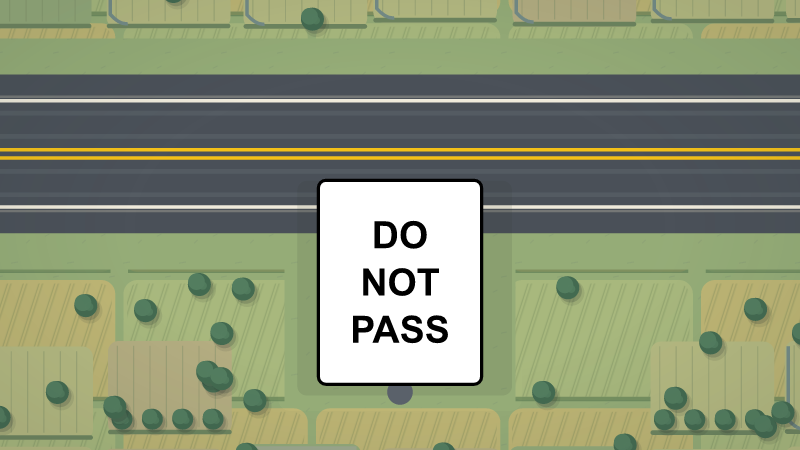
- Do not overtake other vehicles Right
- Do not park on the shoulder
- Do not turn left here
- Do not follow too closely
The right answer is A: Do not overtake other vehicles
WhyDO NOT PASS means you may not overtake another vehicle in that zone.
Topics to review
- Signs
- Traffic signals
- Pavement markings
- Intersections and turns
- Right-of-way
- Sharing the road
- Alcohol and drugs
- Speed and space
- Seat belts and child safety
- Night and bad weather
- Distraction
- Emergencies
- Lanes
- Passing
- Highways
- Regulatory signs
- Warning signs
- Guide and service signs
- Pavement markings
- Emergency vehicles and crashes
- Learner and provisional licenses
- Driver education
- Seat belts and child seats
- Alcohol and DWI
- Parking
- Speed limits
- Sharing the road
- Headlights
- Insurance
- Phones and distraction
Your topics
- SignsKnow it
- Learner and provisional licensesOn the way
- Right-of-wayStamped
In the app, questions you miss come back until you get them right. 5 questions a day are free.
45 free questions on this website and 379 in the app, checked against the MUTCD, the Uniform Vehicle Code and Texas law, with the reason for every answer. About the app
Out now on iPhone and Android.


Next: the 25-question permit practice test, the road signs quiz and the road signs library. Other states: permit test by state.
Common questions
How many questions can you miss on the Pennsylvania permit test?
Three. The test has 18 questions and you need 15 right.
Do you need a physical to get a learner’s permit in Pennsylvania?
Yes. A health care provider completes the physical exam on the back of the DL-180, no earlier than six months before your 16th birthday.
What happens if you fail the Pennsylvania permit test?
You can take it again the following business day.
How many practice hours does a Pennsylvania teen need?
At least 65, including 10 at night and 5 in bad weather, before the road test, and the permit must be at least six months old.