The Minnesota permit test, explained
The short answer
In Minnesota you can take the knowledge test for an instruction permit at 15, after 30 hours of driver education classroom time and while enrolled in behind-the-wheel training. You need 80 percent to pass and can take one test a day, at a DVS exam station or an approved testing provider.
Source: Minnesota Driver’s Manual, Driver and Vehicle Services
Minnesota asks for the classroom part of driver education before the permit test, and a parent who takes a 90-minute class can cut the practice hours from 50 to 40.
This text was written with AI help, checked against the Minnesota Driver and Vehicle Services pages and Driver’s Manual and approved by Fri Vei AS. Last updated .
Checked against Minnesota Driver and Vehicle Services · Report a mistake
Drivoku is not connected to Minnesota Driver and Vehicle Services (DVS), part of the Department of Public Safety. Every fact below links to the DVS page or the Minnesota Driver’s Manual it comes from, checked on November 4, 2026.
The Minnesota permit test at a glance
| Minimum age | 15 (Driver’s Manual) |
|---|---|
| Before the test (under 18) | 30 hours of driver education in the classroom, and enrolled in behind-the-wheel training |
| Number of questions | Not on the DVS pages we read |
| Passing score | 80 percent |
| Where | A DVS exam station or an approved testing provider (DVS lists where and how you can take it, including any online option, so check its page before you book) (DVS testing agreement, 2025) |
| Retakes | One test a day; a $10 fee from the third try after two fails in a row |
| Valid for | Two years, renewable |
How many questions are on the Minnesota permit test?
We could not find the number on the DVS pages or in the manual we read. The Minnesota Driver’s Manual gives the rules around it: you must score 80 percent to pass, you can take only one knowledge test a day, and after two failed tests in a row the third and later tries cost $10. DVS also publishes a practice test drawn from the manual.
Do you need driver’s ed for a permit in Minnesota?
Yes, if you are under 18. You show an enrollment card from an approved driver education course (the “blue card” or “pink card”), which says you have finished the classroom part and are enrolled in behind-the-wheel training. From 18, the classroom part is not required.
What to bring
- Your driver education enrollment card, if you are under 18.
- Your identification. We have not checked the DVS document list, so read it on the DVS page for new drivers under 18 before you go.
Rules for teen drivers in Minnesota
Minnesota, like every state, uses graduated driver licensing. From the Department of Public Safety pages on the graduated driver’s license and teen driver laws:
- With the permit: drive with a licensed supervisor aged 21 or older. Under 18, hold the permit for at least six months before the road test.
- Practice: at least 50 hours with a parent or guardian, 15 of them at night, logged and signed. If a parent or guardian takes the 90-minute parent awareness class, the requirement drops to 40 hours.
- Provisional license, first six months: no driving from midnight to 5 a.m., except with a licensed driver aged 25 or older, to or from work, between home and a school event for which transportation is not provided, or for your job. At most one passenger under 20, unless a parent or guardian is with you.
- Provisional license, next six months: at most three passengers under 20, unless a parent or guardian is with you. Immediate family members do not count toward these limits.
What Drivoku covers for Minnesota
Our free permit practice test and the questions below cover road rules and signs that apply in every state, with signs from the national sign manual. They do not cover Minnesota’s own laws; the Minnesota Driver’s Manual has those.
Practice five questions every state shares
Five shared road rules
Answer one question at a time. You see the answer and the reason after each one. Nothing you pick is saved or sent anywhere.
-
Seat belts and child safety
Every rear seat in your car allows a correct car-seat installation. Which spot is unsafe for a rear-facing child safety seat?
- The middle seat in the back row
- Front seat, facing an active air bag Right
- Behind the driver's seat
- Beside a rear-side window
The right answer is B: Front seat, facing an active air bag
WhyA rear-facing seat must never go in front of an active air bag, whose force can seriously injure a child.
-
Traffic signals
A steady yellow left-turn arrow is showing. What does it tell you?
- The left-turn movement is ending; prepare to stop Right
- You now have the right-of-way to turn
- Left turns are now forbidden
- The arrow is about to turn green
The right answer is A: The left-turn movement is ending; prepare to stop
WhyA steady yellow arrow warns that the current left-turn movement is ending; prepare to stop.
Source: MUTCD Section 4A.03 Meanings of Steady Vehicular Signal Indications
-
Signs
A white sign reads DO NOT PASS. What does it mean?
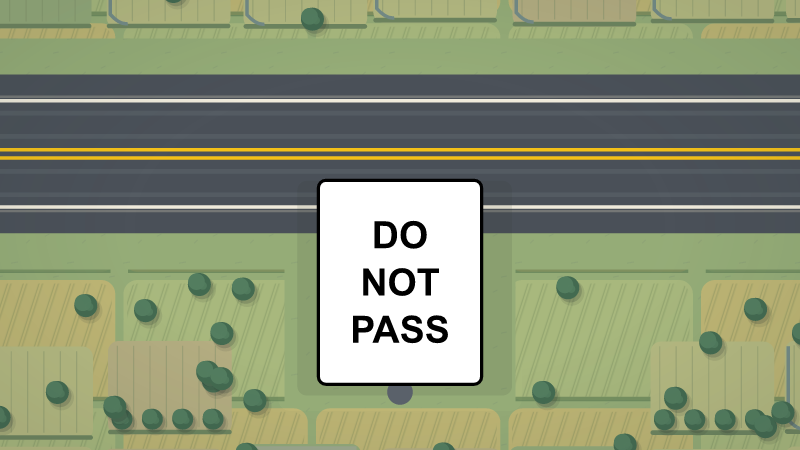
- Do not overtake other vehicles Right
- Do not park on the shoulder
- Do not turn left here
- Do not follow too closely
The right answer is A: Do not overtake other vehicles
WhyDO NOT PASS means you may not overtake another vehicle in that zone.
-
Pavement markings
A white arrow painted in your lane curves left. What does it tell you?
- Left turns are forbidden here
- This lane is for left turns Right
- The road curves left up ahead
- You may turn left or go straight
The right answer is B: This lane is for left turns
WhyA lane-use arrow shows the movements allowed or required in that lane.
-
Intersections and turns
You face a steady circular green and plan a permitted left turn. An oncoming car is close enough to conflict with your turn. A pedestrian is also lawfully crossing your turning path. What must happen before you turn?
- The pedestrian clears your path; the car must yield
- The oncoming car passes; the pedestrian must wait
- You signal; the car and pedestrian must then yield
- You yield until each conflict clears Right
The right answer is D: You yield until each conflict clears
WhyOn a circular green, left turns yield to conflicting oncoming vehicles and pedestrians lawfully in the crosswalk.
Source: MUTCD Section 4A.03 Meanings of Steady Vehicular Signal Indications, UVC § 11-402 Vehicle turning left (model law)
Topics to review
- Signs
- Traffic signals
- Pavement markings
- Intersections and turns
- Right-of-way
- Sharing the road
- Alcohol and drugs
- Speed and space
- Seat belts and child safety
- Night and bad weather
- Distraction
- Emergencies
- Lanes
- Passing
- Highways
- Regulatory signs
- Warning signs
- Guide and service signs
- Pavement markings
- Emergency vehicles and crashes
- Learner and provisional licenses
- Driver education
- Seat belts and child seats
- Alcohol and DWI
- Parking
- Speed limits
- Sharing the road
- Headlights
- Insurance
- Phones and distraction
Your topics
- SignsKnow it
- Learner and provisional licensesOn the way
- Right-of-wayStamped
In the app, questions you miss come back until you get them right. 5 questions a day are free.
45 free questions on this website and 379 in the app, checked against the MUTCD, the Uniform Vehicle Code and Texas law, with the reason for every answer. About the app
Out now on iPhone and Android.


Keep going with the 25-question permit practice test and the road signs quiz. Other states: permit test by state.
Common questions
What score do you need on the Minnesota permit test?
80 percent.
How many times can you take the Minnesota permit test?
One test a day. After two fails in a row, each further try costs $10.
How many hours of driving do you need in Minnesota?
50 hours with a parent or guardian, 15 at night, or 40 hours if a parent or guardian takes the parent awareness class.