The Indiana permit test, explained
The short answer
The Indiana knowledge exam has two parts, traffic signs and traffic rules, and you need at least 80 percent on each part to pass. The BMV does not publish the number of questions. You can get a learner’s permit at 15 if you are enrolled in driver education, or at 16 without it.
In Indiana the first, probationary license expires 30 days after your 21st birthday, and for its first 180 days you may not carry passengers, apart from a few adults and family members.
This text was written with AI help, checked against the Indiana Bureau of Motor Vehicles’ pages and approved by Fri Vei AS. Last updated .
Checked against the Indiana Bureau of Motor Vehicles · Report a mistake
Drivoku is not connected to the Indiana Bureau of Motor Vehicles (BMV). Every fact below links to the BMV page it comes from, checked on November 3, 2026.
The Indiana permit test at a glance
| Minimum age | 15 if enrolled in an approved behind-the-wheel course; 16 without driver education (BMV) |
|---|---|
| The exam | Multiple choice, in two parts: traffic maneuvers and types of traffic signs (BMV) |
| Number of questions | Not stated on the BMV’s exam page |
| Passing score | 80 percent or higher on each part |
| Where | A computer-based exam at a BMV branch; arrive at least 30 minutes before it closes |
| If you fail | Try again as early as the next business day; a pass is valid for 180 days |
| Languages | English and about 20 others, and American Sign Language with an interpreter |
How many questions are on the Indiana permit test?
The BMV’s knowledge exam page does not say. It says the exam is multiple choice, has one part on traffic maneuvers and one on types of traffic signs, and that you need 80 percent or higher on each part. A strong score on one part does not make up for a weak one on the other. If you fail, you can take it again as early as the next business day, and once you pass, the result is valid for 180 days.
What to bring to the BMV
From the BMV’s learner’s permit page:
- Documents proving your identity, Social Security number and lawful status, and two different documents proving Indiana residency. The page links a checklist.
- If you are 15 and in driver education: your Certificate of Driver Education.
- You also pass a vision screening. The exam usually needs no appointment.
Rules for teen drivers in Indiana
Indiana, like every state, uses graduated driver licensing.
- With a permit: your supervisor sits in the front passenger seat and is a licensed driving instructor, a licensed relative aged 25 or older, or your licensed spouse aged 21 or older (learner’s permit page).
- For the probationary license: hold the permit for 180 days, be at least 16 with driver education (or 16 years and 270 days without), and bring a signed Log of Supervised Driving (probationary license page).
- First 180 days of the license: no driving between 10 p.m. and 5 a.m., and no passengers, with exceptions for some adults and family members. Later limits apply until 18.
- Phones: no telecommunication device while driving, except to call 911 in an emergency. The license expires 30 days after your 21st birthday.
What Drivoku covers for Indiana
Our free permit practice test, the road signs quiz and the questions below cover road rules and signs that apply in every state, with signs from the national sign manual. They do not cover Indiana’s own laws, so read the Indiana driver’s manual as well.
Practice five questions every state shares
Five shared road rules
Answer one question at a time. You see the answer and the reason after each one. Nothing you pick is saved or sent anywhere.
-
Intersections and turns
You face a steady circular green and plan a permitted left turn. An oncoming car is close enough to conflict with your turn. A pedestrian is also lawfully crossing your turning path. What must happen before you turn?
- The pedestrian clears your path; the car must yield
- The oncoming car passes; the pedestrian must wait
- You signal; the car and pedestrian must then yield
- You yield until each conflict clears Right
The right answer is D: You yield until each conflict clears
WhyOn a circular green, left turns yield to conflicting oncoming vehicles and pedestrians lawfully in the crosswalk.
Source: MUTCD Section 4A.03 Meanings of Steady Vehicular Signal Indications, UVC § 11-402 Vehicle turning left (model law)
-
Pavement markings
A center lane is bordered by solid and broken yellow lines on each side and shows left-turn arrows. What is it for?
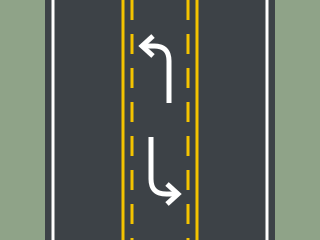
- Left turns from either direction Right
- Passing slower traffic on both sides
- Parking while you run errands
- Buses and carpools only
The right answer is A: Left turns from either direction
WhyA center lane with left-turn arrows is a two-way left-turn lane for turning left from either direction.
Source: MUTCD Section 3B.05 Pavement Markings for Two-Way Left-Turn Lanes
-
Sharing the road
Red lights are flashing at a railroad crossing, but the gate is still raised and you cannot see a train. No officer is directing traffic. What should you do?
- Stop before the tracks; wait until the lights stop and it is safe Right
- Cross slowly while watching for a train in both directions
- Continue across because the raised gate permits travel
- Stop only if a train becomes visible near the crossing
The right answer is A: Stop before the tracks; wait until the lights stop and it is safe
WhyFlashing crossing lights mean stop before the tracks; a raised gate does not cancel them.
Source: UVC § 11-701(a) Obedience to signal indicating approach of train (model law)
-
Alcohol and drugs
Some medicines you can buy without a prescription can make you drowsy or dizzy. What does this mean for driving?
- They are safe once you feel awake
- They can impair your driving Right
- Only prescription drugs impair driving
- They only matter at high doses
The right answer is B: They can impair your driving
WhySome over-the-counter and prescription medicines cause drowsiness or dizziness and can impair your driving.
Source: NHTSA: Drug-Impaired Driving, Many Substances Can Impair Driving
-
Emergencies
You slept very little, drank coffee, and now begin drifting out of your lane. A designated rest area is just ahead. What is the safest response?
- Pull into the rest area and stop to rest Right
- Keep driving because the coffee will prevent sleep
- Open the windows and continue until your destination
- Turn the music louder and increase your driving speed
The right answer is A: Pull into the rest area and stop to rest
WhyCoffee alone may not prevent microsleeps; stop in a safe place when sleepiness affects your driving.
Topics to review
- Signs
- Traffic signals
- Pavement markings
- Intersections and turns
- Right-of-way
- Sharing the road
- Alcohol and drugs
- Speed and space
- Seat belts and child safety
- Night and bad weather
- Distraction
- Emergencies
- Lanes
- Passing
- Highways
- Regulatory signs
- Warning signs
- Guide and service signs
- Pavement markings
- Emergency vehicles and crashes
- Learner and provisional licenses
- Driver education
- Seat belts and child seats
- Alcohol and DWI
- Parking
- Speed limits
- Sharing the road
- Headlights
- Insurance
- Phones and distraction
Your topics
- SignsKnow it
- Learner and provisional licensesOn the way
- Right-of-wayStamped
In the app, questions you miss come back until you get them right. 5 questions a day are free.
45 free questions on this website and 379 in the app, checked against the MUTCD, the Uniform Vehicle Code and Texas law, with the reason for every answer. About the app
Out now on iPhone and Android.


For the signs part, use the road signs library. Other states: permit test by state.
Common questions
What score do you need on the Indiana permit test?
At least 80 percent on each of the two parts: traffic maneuvers and traffic signs.
How many questions are on the Indiana permit test?
The BMV’s exam page does not give the number. It describes a multiple-choice exam in two parts.
Can you get a permit at 15 in Indiana?
Yes, if you are enrolled in an approved behind-the-wheel driver education course. Without driver education you must be 16.
What happens if you fail the Indiana permit test?
You can take it again as early as the next business day.