The Connecticut permit test, explained
The short answer
The Connecticut knowledge test has 25 questions, and you need at least 20 right to pass. You take it in person, by appointment, at one of ten DMV offices, after a vision test. The legal age for a learner’s permit is 16. The $40 testing fee covers the vision, knowledge and road tests, and the permit itself costs $19.
Connecticut tests your eyes first. If you do not pass the vision test, you cannot take the knowledge test that day and must book again.
This text was written with AI help, checked against the Connecticut DMV’s pages and approved by Fri Vei AS. Last updated .
Checked against the Connecticut Department of Motor Vehicles · Report a mistake
Drivoku is not connected to the Connecticut Department of Motor Vehicles (DMV). Every fact below links to the DMV page it comes from, checked on November 4, 2026.
The Connecticut permit test at a glance
| Minimum age | 16 (DMV) |
|---|---|
| Number of questions | 25 (DMV) |
| Passing score | At least 20 of 25 |
| Where | In person, by appointment, at ten DMV offices |
| Fees | $40 for the vision, knowledge and road tests; $19 for the permit |
| If you fail | Wait seven days and pay $40 to book again |
How many questions are on the Connecticut permit test?
Twenty-five, based on the Connecticut driver’s manuals. You need at least 20 right, so you can miss 5 (DMV: knowledge and vision test). The test is offered in 11 languages, including English, Spanish and Arabic, and you can ask for a printed test in about two dozen more. If you fail, you wait seven days and pay $40 to book a new appointment.
Where do you take the Connecticut permit test?
Only in person, by appointment, at these DMV offices: Bridgeport, Cheshire, Danbury, Enfield, Hamden, Norwalk, Old Saybrook, Waterbury, Wethersfield and Willimantic (teen driver’s license).
What to bring
- The completed application, form R-229 (Application for Non-Commercial Learner’s Permit and/or Driver’s License).
- Your identity documents, as the DMV lists them.
- Your glasses or contact lenses, if you need them.
- A parent or guardian, or the Certificate of Parental Consent (form 2-D) if they cannot come.
Rules for teen drivers in Connecticut
Connecticut, like every state, uses graduated driver licensing. From the DMV pages on the teen driver’s license and restrictions for 16- and 17-year-olds:
- Training: through high school driver education, a commercial driving school or home training. The school routes include 22 hours in class and an 8-hour safe driving course with 2 hours of parent training; home training includes 30 hours in class with the safe driving course and 2 hours of parent training.
- With the permit: no passengers except a parent, legal guardian or qualified trainer. No phone use, not even hands-free.
- Before the license: hold the permit for at least 120 days if you train with a driving school or high school, or 180 days with home training, and log 40 hours of practice.
- License, first six months: passengers only a licensed driving instructor, your parents or guardians (one of them licensed), or a person aged 20 or older licensed for at least four years. In the next six months, brothers and sisters may ride too.
- Licensed drivers under 18, nights and phones: no driving from 11 p.m. to 5 a.m., except for work, school, religious activities or medical need, and no phone use, not even hands-free.
What Drivoku covers for Connecticut
Our free permit practice test and the questions below cover road rules and signs that apply in every state, with signs from the national sign manual. They do not cover Connecticut’s own laws; the Connecticut driver’s manual has those, and the test is based on it.
Practice five questions every state shares
Five shared road rules
Answer one question at a time. You see the answer and the reason after each one. Nothing you pick is saved or sent anywhere.
-
Intersections and turns
You plan to turn onto a one-way street. Its permitted traffic direction runs from your left to your right. There are no other turn restrictions. Which turn follows that street's legal direction?
- A left turn across the near side of the street
- Either turn if the destination street is empty
- A left turn followed by an immediate lane change
- A right turn Right
The right answer is D: A right turn
WhyEnter a one-way street only in its designated direction of travel.
Source: UVC § 11-308(b) One-way roadways and rotary traffic islands (model law)
-
Speed and space
Which statement about your speed is correct?
- You must never drive below the posted limit, even in bad weather
- Drive at a safe speed for conditions; don't needlessly block normal traffic Right
- The posted limit is only a suggestion
- You must match the speed of the fastest car
The right answer is B: Drive at a safe speed for conditions; don't needlessly block normal traffic
WhyDrive at a safe speed for conditions, even below the limit, but don't needlessly impede normal traffic.
Source: UVC § 11-801 Basic rule (model law), UVC § 11-805 Minimum speed regulation (model law)
-
Traffic signals
A steady green arrow points left while the circular light is red. A pedestrian is still crossing directly in your intended turning path. What must you do?
- Turn left now; the arrow gives you the right-of-way
- Turn left and stop inside the crosswalk
- Go straight instead, since the arrow is on
- Yield to the pedestrian, then turn when safe and permitted Right
The right answer is D: Yield to the pedestrian, then turn when safe and permitted
WhyA green arrow allows the left turn, but you must still yield to pedestrians in the crosswalk.
Source: MUTCD Section 4A.03 Meanings of Steady Vehicular Signal Indications
-
Seat belts and child safety
Every rear seat in your car allows a correct car-seat installation. Which spot is unsafe for a rear-facing child safety seat?
- The middle seat in the back row
- Front seat, facing an active air bag Right
- Behind the driver's seat
- Beside a rear-side window
The right answer is B: Front seat, facing an active air bag
WhyA rear-facing seat must never go in front of an active air bag, whose force can seriously injure a child.
-
Pavement markings
A center lane is bordered by solid and broken yellow lines on each side and shows left-turn arrows. What is it for?
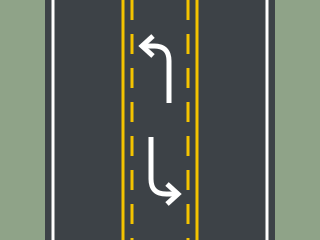
- Left turns from either direction Right
- Passing slower traffic on both sides
- Parking while you run errands
- Buses and carpools only
The right answer is A: Left turns from either direction
WhyA center lane with left-turn arrows is a two-way left-turn lane for turning left from either direction.
Source: MUTCD Section 3B.05 Pavement Markings for Two-Way Left-Turn Lanes
Topics to review
- Signs
- Traffic signals
- Pavement markings
- Intersections and turns
- Right-of-way
- Sharing the road
- Alcohol and drugs
- Speed and space
- Seat belts and child safety
- Night and bad weather
- Distraction
- Emergencies
- Lanes
- Passing
- Highways
- Regulatory signs
- Warning signs
- Guide and service signs
- Pavement markings
- Emergency vehicles and crashes
- Learner and provisional licenses
- Driver education
- Seat belts and child seats
- Alcohol and DWI
- Parking
- Speed limits
- Sharing the road
- Headlights
- Insurance
- Phones and distraction
Your topics
- SignsKnow it
- Learner and provisional licensesOn the way
- Right-of-wayStamped
In the app, questions you miss come back until you get them right. 5 questions a day are free.
45 free questions on this website and 379 in the app, checked against the MUTCD, the Uniform Vehicle Code and Texas law, with the reason for every answer. About the app
Out now on iPhone and Android.


Keep going with the 25-question permit practice test, the same length as the Connecticut test, and the road signs quiz. Other states: permit test by state.
Common questions
How many questions can you miss on the Connecticut permit test?
Five. You need at least 20 of 25 right.
How much is the Connecticut permit test?
$40, which covers the vision, knowledge and road tests. The permit costs $19.
Can you take the Connecticut permit test online?
No. The DMV says all testing is in person, by appointment.
What happens if you fail the Connecticut permit test?
You wait seven days and pay $40 to book a new appointment.